
Serengeti National Park Photos: What the Park Looks Like
Serengeti photos: plains and acacias, zebra herds, hippo pools, big cats and rollers, with the lens and settings behind each frame.
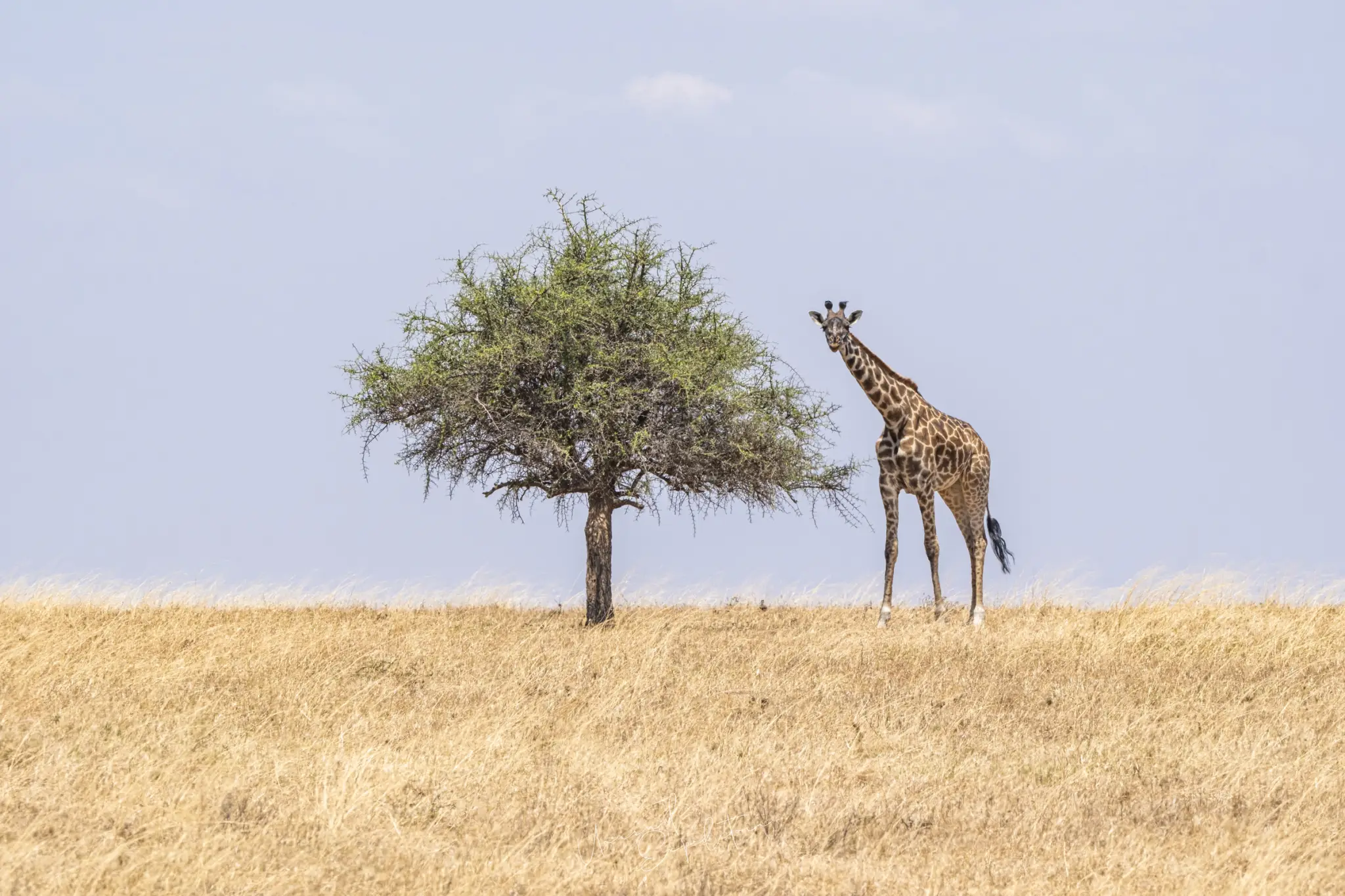
Serengeti photos show a wide, pale gold plain under a big sky, broken by single acacia trees, granite kopjes and lines of animals walking to water. Close up, they show the animals themselves: zebra stripes filling the frame, hippos packed into a pool, a lilac-breasted roller on a branch, a leopard in a tree. The colours change with the season, gold and dust in the dry months, green after the rains, and the light is at its best in the first and last hour of the day.
This is a companion to our Serengeti photography tour guide. The photographs here are our own, taken on our trips to Serengeti National Park over several seasons; we hold the rights to them, and the notes come from knowing the park first hand.
Serengeti National Park photos: the landscape
The landscape in Serengeti National Park photos is simpler than people expect. Much of the centre and south is open grassland, flat to gently rolling, where one tree can be the whole composition. That simplicity is the opportunity: a giraffe walking past a lone acacia on a ridge needs nothing else in the frame. Put the horizon low when the sky has shape, high when the grass has texture, and leave space in the direction the animal is walking. The north is different, with more trees, river valleys and the Mara River cutting through it, so frames there feel closer and busier. The kopjes, granite outcrops rising out of the plain, add a third kind of picture: rounded boulders, fig trees growing from the cracks and often a lion or leopard on top.
Serengeti safari photos of the herds
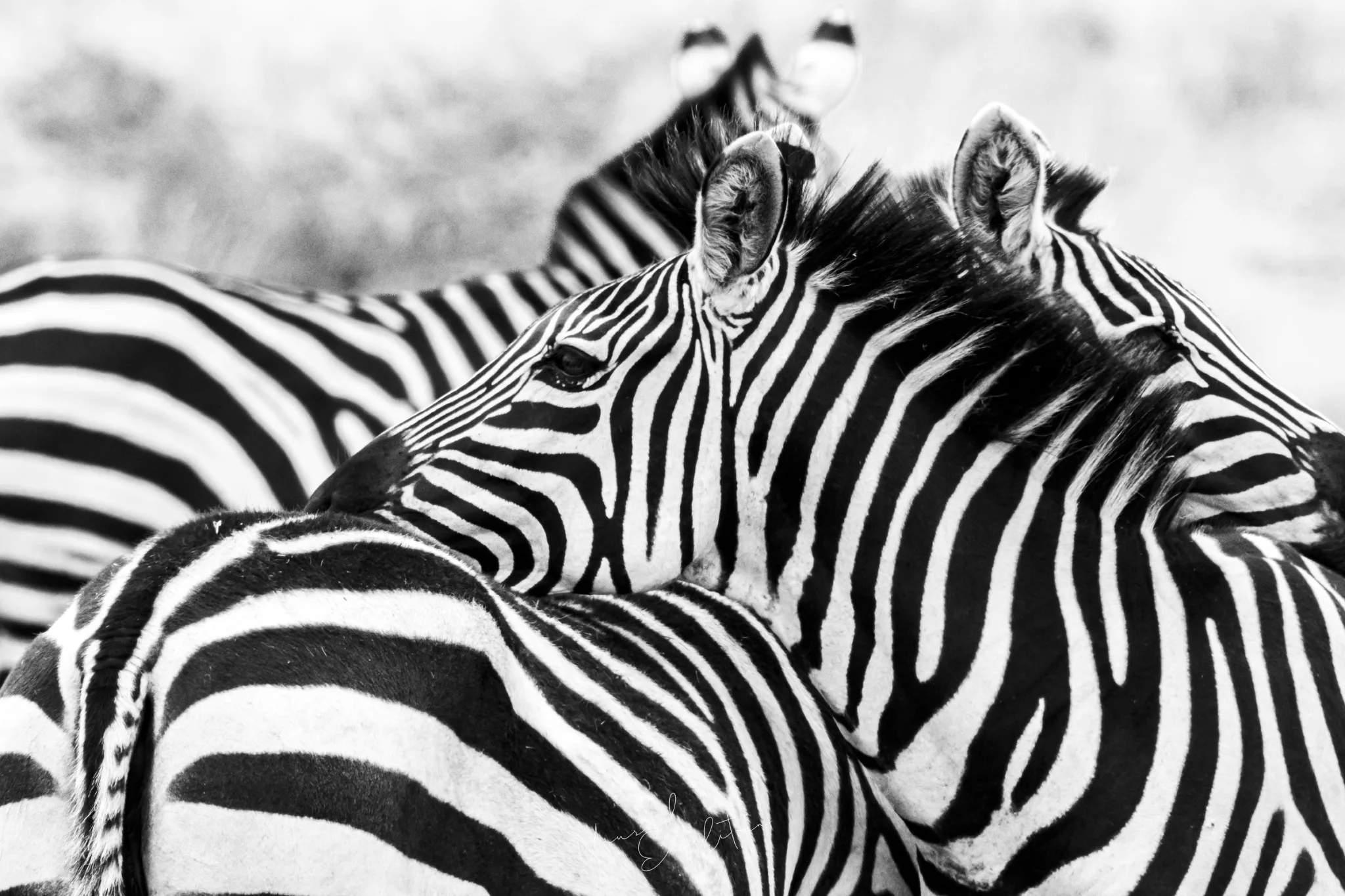
Most Serengeti safari photos of the migration are one of three kinds, and there is no shortage of subjects: UNESCO's World Heritage listing counts some two million wildebeest on the move, with hundreds of thousands of zebras and gazelles. Wide frames show a line of wildebeest and zebra stretching to the horizon, which needs height or a long view across open ground. Tight frames fill the picture with bodies and horns, best with a 200-400mm or 100-400mm from the vehicle roof. And slow pans, at around 1/30s to 1/60s, turn running animals into streaks with one head sharp. Zebras reward close attention: two or three standing together become an abstract pattern, and a black and white conversion often suits them better than colour. The herds are not everywhere at once; where they are depends on the month and the rain, which we cover in the best time to visit the Serengeti guide.
Photos of the Serengeti rivers and pools
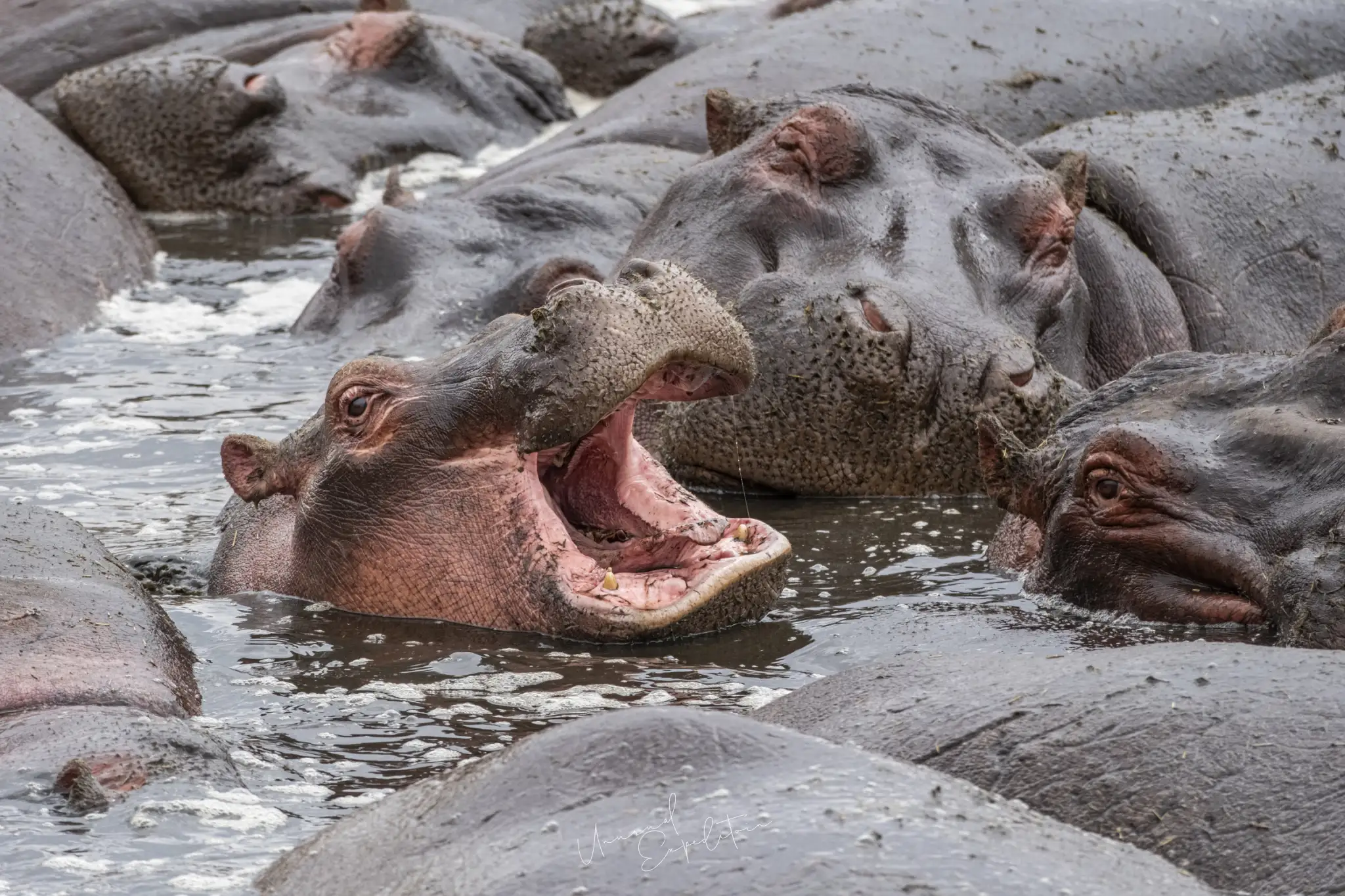
Water draws everything in a dry landscape. The Mara River in the north gives the crossing pictures, and the Mara River crossing guide covers those in detail. Elsewhere the river pools hold hippos in crowds, half-submerged and constantly shifting, with the occasional open-mouthed yawn that is the frame everyone waits for. Watch the dominant animals at the edge of the group; they open their mouths more often, and a fast shutter at 1/1000s keeps the spray sharp. Crocodiles lie along the banks nearby. Elephants come down to drink and sometimes wade across, and families with calves give the most natural pictures if the vehicle stays well back. Pools are also good places to wait in the middle of the day, when the plains go quiet.
Big cats in Serengeti photos
Lions, leopards and cheetahs are the reason many people book, and they are what most Serengeti photos online show. The cats spend much of the day lying down, so the best frames come either at the edges of the day, when they move, hunt and play, or from small moments in the middle: a yawn, a look straight at the lens, a cub climbing over its mother. A leopard in a tree is the classic Serengeti picture; frame it with the branches and wait for the head to turn. Cheetahs on a termite mound, scanning the plain, give a cleaner outline. Our Serengeti big cats article has the details for each cat.
Birds of the Serengeti
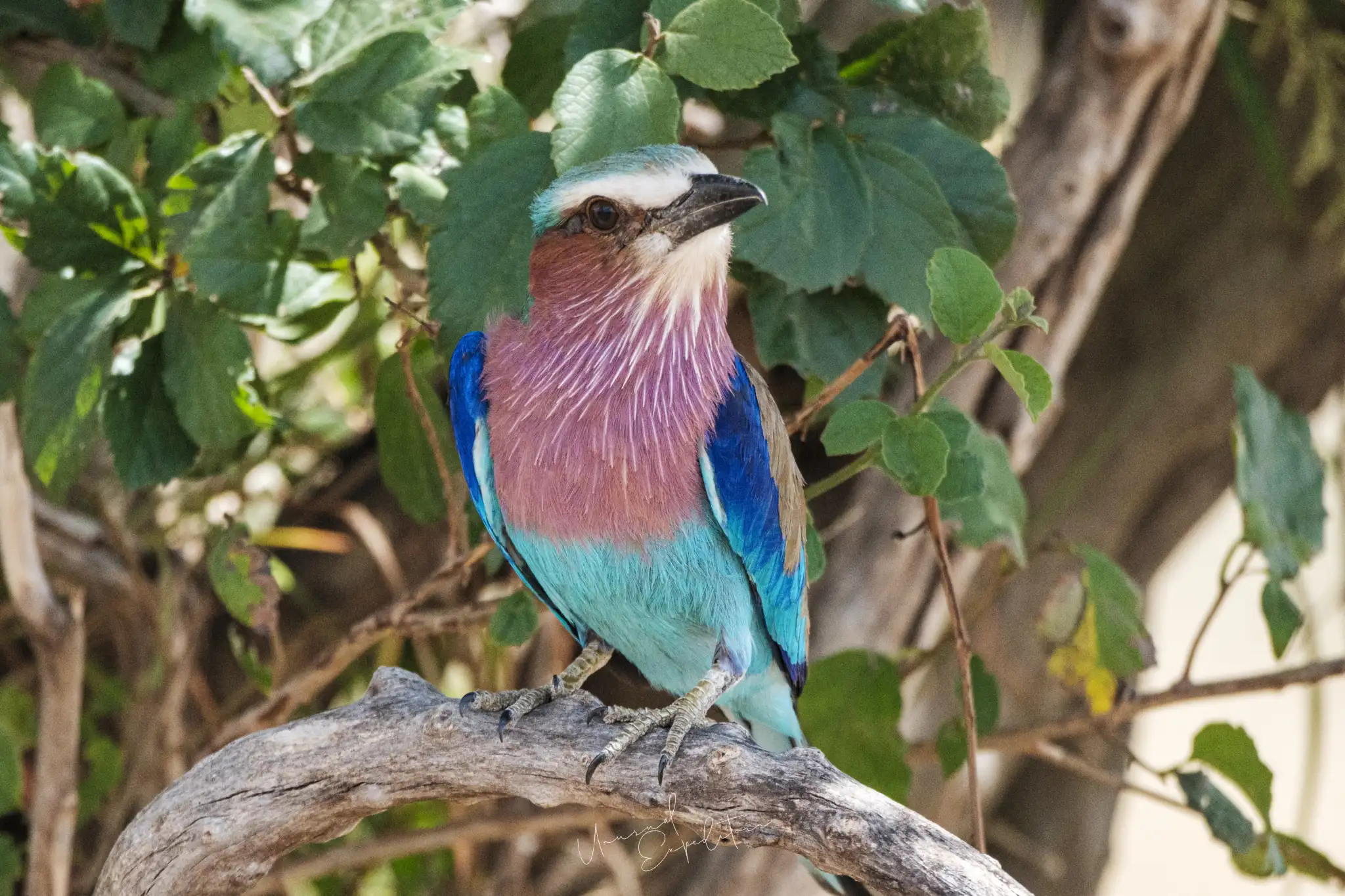
Bird photos are the surprise of most Serengeti trips. The lilac-breasted roller, with its blue, lilac and green plumage, perches in the open on dead branches and lets vehicles come close; it is the most photographed bird in East Africa for a reason. Raptors sit on acacia tops: chanting goshawks, tawny eagles, bateleurs. Vultures gather at a carcass and give some of the most dramatic, if gory, close-ups of a trip. Ostriches and kori bustards walk the open grassland, and storks follow the smoke of a grass fire to catch fleeing insects. For birds in flight a fast zoom and a shutter of 1/2000s or quicker are the starting point.
How the photos were made
All of the frames in this set were taken from safari vehicles with open roofs, because the rules of Tanzania National Parks (TANAPA) keep visitors in the vehicle except at designated places. That shapes the pictures. You shoot from well above the ground, which flattens small animals; when the driver can stop low on a slope, take it. A bean bag on the roof edge is steadier than any tripod. The lenses we use most are a 100-400mm or 200-400mm for the cats and birds, a 70-200mm for elephants and groups, and a 24-70mm for the landscape and sunsets.
| Subject | Lens | Starting shutter speed |
|---|---|---|
| Leopard in a tree, birds perched | 200-400mm or 100-400mm | 1/500s |
| Lions, cheetahs at rest | 100-400mm or 70-200mm | 1/500s |
| River crossing, running herd | 70-200mm and 100-400mm | 1/2000s |
| Panning a herd | 70-200mm | 1/30s to 1/60s |
| Landscape and sunset | 24-70mm | Tripod not possible: lean on the roof |
The fast speeds matter more than the lens: most missed frames on safari are motion blur, not framing.
People ask me which lens took a picture and it is usually the wrong question. The zebra frame I like most here was taken because we waited by the same small herd until three heads lined up.
Joseph Mak, tour leader, Unusual Expedition
Colour, dust and season in the pictures
Serengeti photos change colour with the season, and it is worth deciding which look you want before you choose your dates. In the dry months the grass is gold to pale straw, the air carries dust that glows when backlit, and the skies are clear. After the rains the southern plains turn green, the air is clean and storm clouds build in the afternoon. Grass fires in the dry season leave black ground and smoke that softens the light. Open grassland, wooded savannah and the trees along the rivers can all appear in a single set of photos. Our Serengeti sunrise and sunset guide covers the warmest light of the day.
Take your own Serengeti photos
The Serengeti Photo Tour 2027 is built around the Mara River and the central Serengeti, with time at each sighting for the picture to develop. Details are on our Tanzania photography tours page.
Ask us about photographing the Serengeti
Join the Serengeti photography tour
Serengeti Photo Tour – Tanzania 2027 departs 21 Aug 2027 To 01 Sep 2027. Small group, photography first. All Serengeti photography tours.
Explore Serengeti in depth
- Serengeti Photography Tour: The Complete GuideTanzania
- Serengeti National Park Big Five: Where to Find and Photograph Each OneTanzania
- Serengeti National Park Zebra: Photographing the Stripes of the MigrationTanzania
- Serengeti National Park Birds: Bateleurs, Vultures, Hornbills and How to Photograph ThemTanzania
- Serengeti Leopards: Finding and Photographing Them in Seronera and on the KopjesTanzania
- Serengeti Photography FAQ: Fees, Weather, Rules and GearTanzania
- Is the Serengeti Worth Visiting? How to Get There and What to ExpectTanzania
- Serengeti Big Cats: Photographing Leopards, Lions and CheetahsTanzania
- Serengeti Sunrise and Sunset: Photographing the Golden HoursTanzania
- Mara River Crossing in the Serengeti: How to Photograph ItTanzania
- Best Time to Visit the Serengeti for Photography, Month by MonthTanzania
Upcoming Photo Tours
- Egypt Photo Tour – EgyptEgypt 12 Dec 2026 To 20 Dec 2026
- Inner Mongolia Winter Owl Photo Tour – ChinaChina 01 Jan 2027 To 04 Jan 2027
- Inner Mongolia Winter Photo Tour – ChinaChina 05 Jan 2027 To 11 Jan 2027
- Mekong And Central Highland Vietnam Photo Tour - VietnamVietnam 16 Jan 2027 To 24 Jan 2027