
Serengeti Leopards: Finding and Photographing Them in Seronera and on the Kopjes
Serengeti National Park leopard guide: Seronera river trees, kopjes, reading a leopard tree, light, lenses and patience.
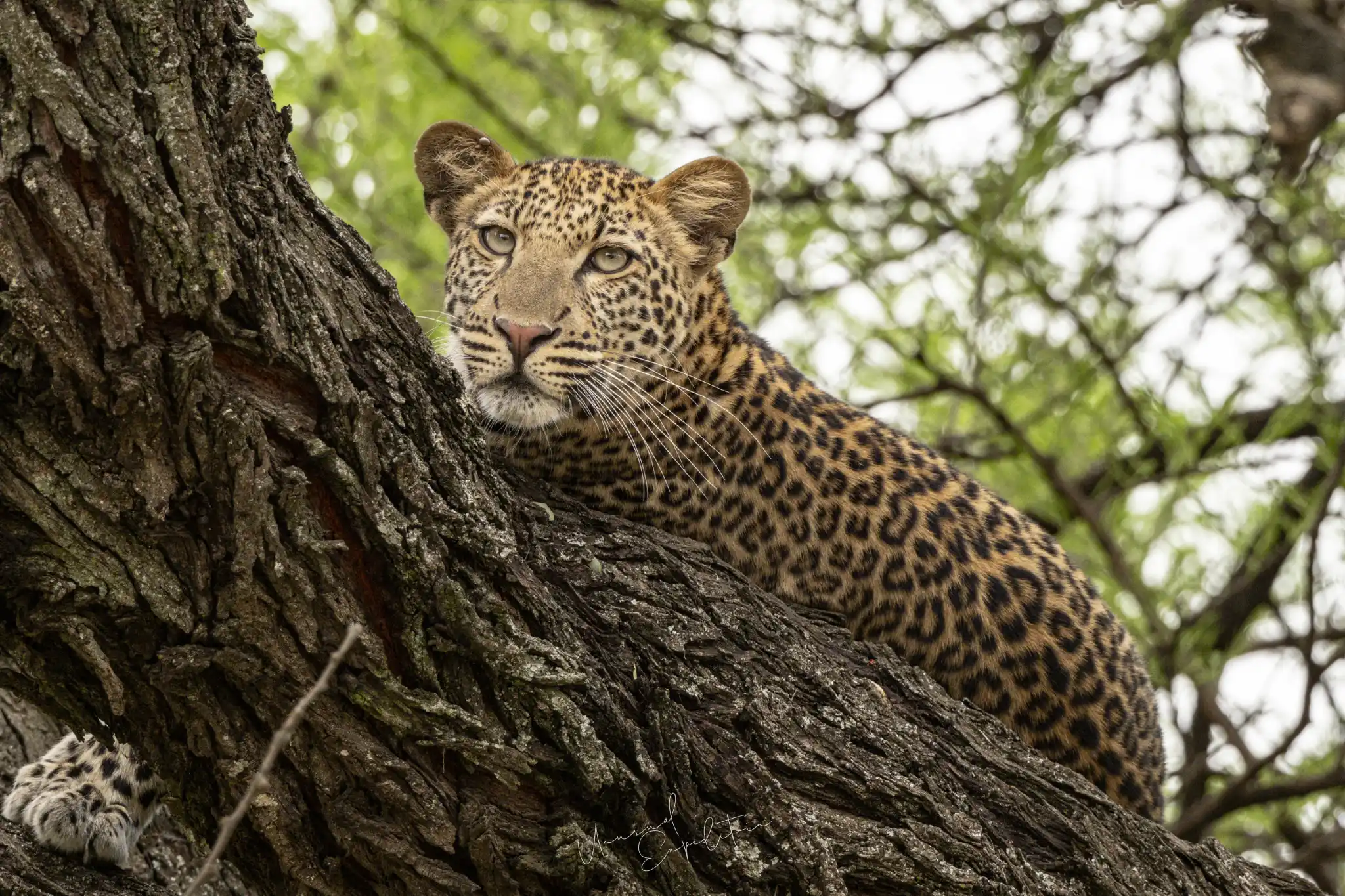
A Serengeti National Park leopard is most often found resting in a tree along the rivers of the central Serengeti around Seronera, or lying on the warm granite of a kopje, and the best chance of photographing one is a slow drive along those river trees in the early morning or late afternoon. Leopards are solitary, mostly active at night and very good at hiding, so a sighting usually means a long wait under a branch for the moment the cat lifts its head, stretches or climbs down.
Leopards are one part of our Serengeti photography tour guide. This destination guide is only about them: where to look, how to read a leopard tree, and how to photograph the cat once you find it.
Serengeti national park leopard: where they live
The Serengeti national park leopard lives across the whole park wherever there is cover, but the central Serengeti is where most photographers find one. The Seronera valley has permanent water, rivers lined with big trees, rocky kopjes nearby and resident prey all year, so leopards hold territories there whether or not the migration herds are close. Safari operators who work in the central park, including Africa Dream Safaris and Four Seasons Serengeti, describe the Seronera river as one of the best places in Tanzania to look for leopards, and that matches our own trips. Leopards also live along the Mara River in the northern Serengeti and among the kopjes in the east and south, but there the search is slower and the sightings less regular.
Seronera Serengeti: the river trees
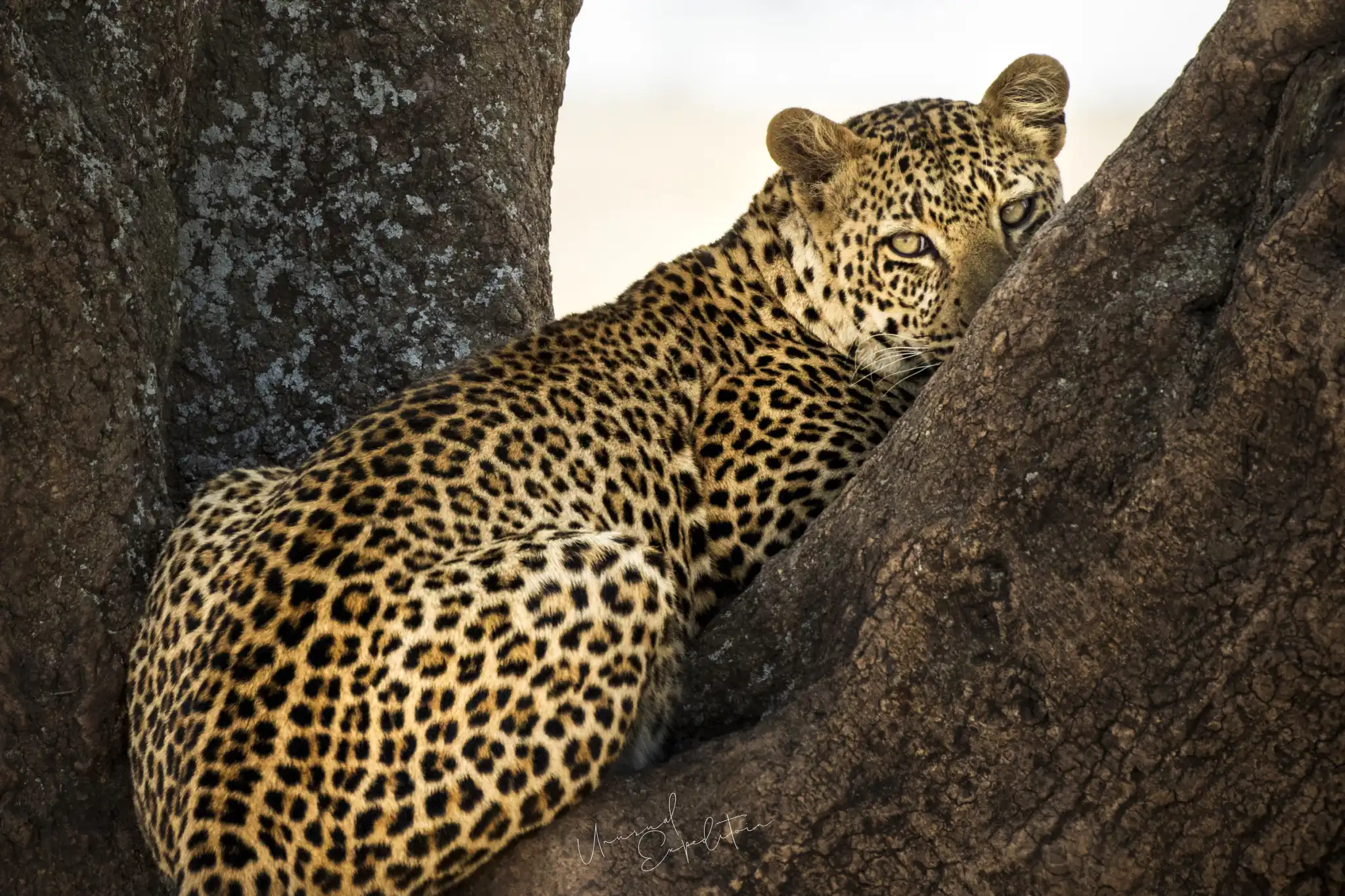
Seronera, in the central Serengeti, is a network of seasonal rivers and streams lined with sausage trees, yellow-barked acacias and figs. Leopards use these trees to rest through the heat, to keep watch over the grass and to store kills out of reach of lions and hyenas. A sausage tree, with its thick horizontal branches, is the classic leopard tree: the cat lies along a branch with its legs hanging down on either side. Vehicles drive the river tracks slowly, scanning each tree. Most of the time the tree is empty; sometimes there is only a tail hanging below the leaves. When a leopard is found, word travels between driver guides and other vehicles arrive, so the first minutes are often the calmest.
How to read a leopard tree
Finding a leopard in the Serengeti is the driver guide's skill, but a photographer who knows the signs spots more. Look along the thick lower branches for a shape that is too smooth to be bark. Check for a long tail with a white tip hanging below the leaves. A carcass wedged in a fork means a leopard is close, even if the tree looks empty, and it will usually come back to feed. Alarm calls from baboons, vervet monkeys or impala, and vultures perched nearby but not landing, can also point to a cat. Once you find one, settle in: choose a position with a clean gap through the leaves, switch off the engine, and wait. TANAPA rules keep vehicles on the tracks in most of the park, so the angle you get is often the angle you keep.
Leopards on the kopjes
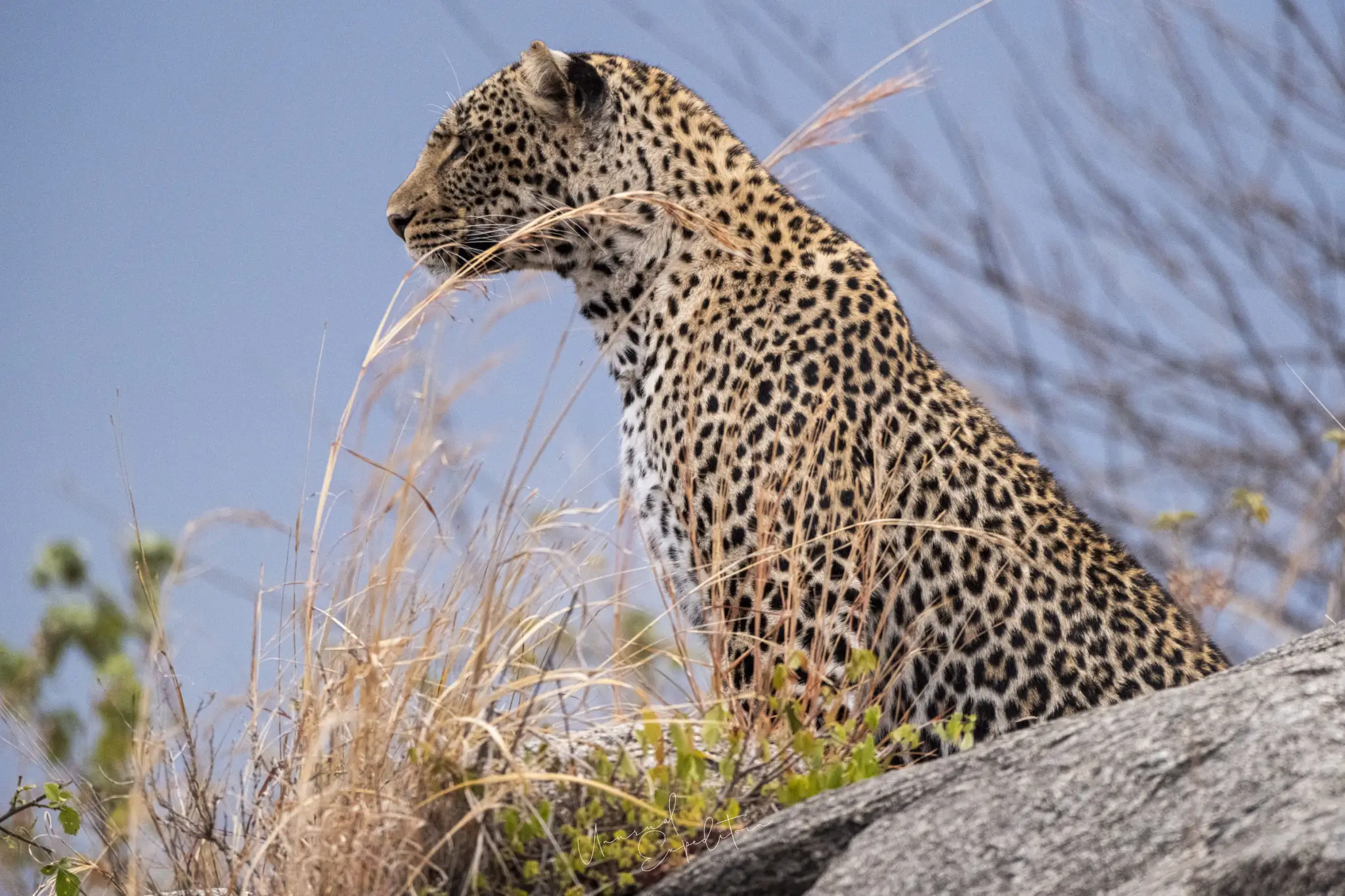
Kopjes are the granite outcrops that rise out of the Serengeti plains, and leopards use them as much as trees. The rocks hold the sun's warmth, the cracks and overhangs give shade and shelter for cubs, and the height gives a lookout over the grass. A leopard sitting upright on a rock against the sky is one of the cleanest pictures in the Serengeti, with none of the branches that clutter a tree shot. The best-known kopjes, such as Simba, Gol, Maasai and Moru, are named on park maps; we do not name the rocks in our own pictures because we cannot place them exactly. Shoot from low to put the cat against the sky, and include the boulder to show where it lives.
Small in the frame
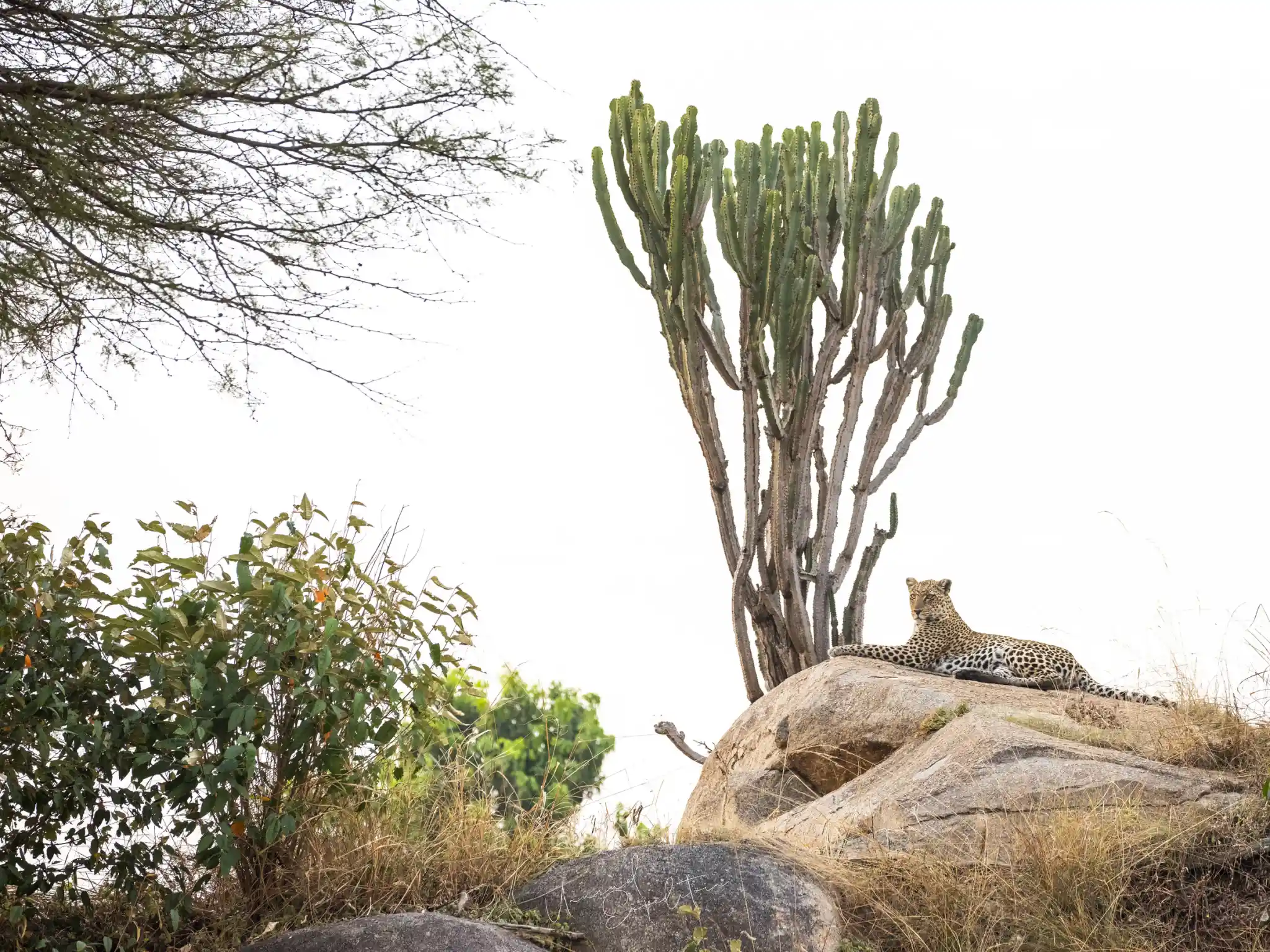
Not every Serengeti leopard picture needs to be a portrait. A leopard lying on top of a kopje, framed wide with a candelabra euphorbia rising behind it and the bush around the rock, says more about the place than a tight head shot. Use a 70-200mm or the short end of a 100-400mm and let the cat take up a small part of the frame, placed where the eye goes first. Bright, overcast skies suit this kind of picture: the light is even, and the shapes of the rock and tree read as a design. Take both, the wide and the tight, at every sighting; the wide one is often the frame you keep.
Serengeti leopard population and why sightings vary
People often ask about the Serengeti leopard population, and no reliable current count is published that we could confirm, so we do not quote one. Leopards are solitary, secretive and mostly nocturnal, which makes them very hard to count. Globally, the leopard is listed as Vulnerable on the IUCN Red List because of habitat loss, conflict with people and hunting. In the Serengeti they are protected, and in the central park they are seen often enough that a few days around Seronera give a good chance of at least one sighting. That chance is not a promise. Some trips find a leopard every day, others wait until the last afternoon. Build in time and do not rely on luck.
Light, lenses and settings for leopards
Leopard light in the Serengeti is difficult, because the cat is usually in shade under leaves with a bright sky behind it. Expose for the coat, not the sky, and add one or two stops of exposure compensation when the background is white. A 100-400mm or 200-400mm covers most tree sightings; a 70-200mm is useful when the cat comes down close to the vehicle.
| Where the leopard is | Best light | Lens | The picture to wait for |
|---|---|---|---|
| In a river tree, Seronera | Late afternoon, early morning | 100-400mm, 200-400mm | Head lifted, yawn, climbing down |
| On a kopje | Early morning, bright overcast | 70-200mm, 100-400mm | Sitting upright against the sky |
| Walking in grass | Any soft light | 100-400mm | Eye contact, a gap in the grass |
Use 1/500s for a resting cat and at least 1/2000s the moment it moves.
A leopard in a tree can sleep through your whole afternoon. Then the light turns warm, it lifts its head and looks straight down the lens for a few seconds. You wait for those seconds, and you only get them if you stayed.
Joseph Mak, tour leader, Unusual Expedition
Waiting well
Patience is most of leopard photography in the Serengeti. Keep the camera on a bean bag, pre-focused on the head, with the shutter speed already set for movement. Talk quietly. Do not ask the driver to reposition every few minutes; each move risks disturbing the cat and other vehicles. If the leopard has a kill in the tree, it will probably feed before dusk, so the late afternoon is worth the wait. For the other cats and how they compare, see Serengeti big cats, and for the golden light that makes leopard pictures, the Serengeti sunrise and sunset guide.
Wait for a leopard with us
Our Serengeti Photo Tour 2027 spends its days in the park beyond the Mara River as well as at it, with time to stay at a leopard tree until the light turns. Details are on the Tanzania photography tours page.
Ask us about photographing leopards in the Serengeti
Join the Serengeti photography tour
Serengeti Photo Tour – Tanzania 2027 departs 21 Aug 2027 To 01 Sep 2027. Small group, photography first. All Serengeti photography tours.
Explore Serengeti in depth
- Serengeti Photography Tour: The Complete GuideTanzania
- Serengeti National Park Big Five: Where to Find and Photograph Each OneTanzania
- Serengeti National Park Zebra: Photographing the Stripes of the MigrationTanzania
- Serengeti National Park Birds: Bateleurs, Vultures, Hornbills and How to Photograph ThemTanzania
- Serengeti Photography FAQ: Fees, Weather, Rules and GearTanzania
- Is the Serengeti Worth Visiting? How to Get There and What to ExpectTanzania
- Serengeti Big Cats: Photographing Leopards, Lions and CheetahsTanzania
- Serengeti Sunrise and Sunset: Photographing the Golden HoursTanzania
- Mara River Crossing in the Serengeti: How to Photograph ItTanzania
- Best Time to Visit the Serengeti for Photography, Month by MonthTanzania
- Serengeti National Park Photos: What the Park Looks LikeTanzania
Upcoming Photo Tours
- Egypt Photo Tour – EgyptEgypt 12 Dec 2026 To 20 Dec 2026
- Inner Mongolia Winter Owl Photo Tour – ChinaChina 01 Jan 2027 To 04 Jan 2027
- Inner Mongolia Winter Photo Tour – ChinaChina 05 Jan 2027 To 11 Jan 2027
- Mekong And Central Highland Vietnam Photo Tour - VietnamVietnam 16 Jan 2027 To 24 Jan 2027