
Serengeti National Park Zebra: Photographing the Stripes of the Migration
Serengeti National Park zebra: their place in the migration, why stripes, and how to photograph herds, dust and details.
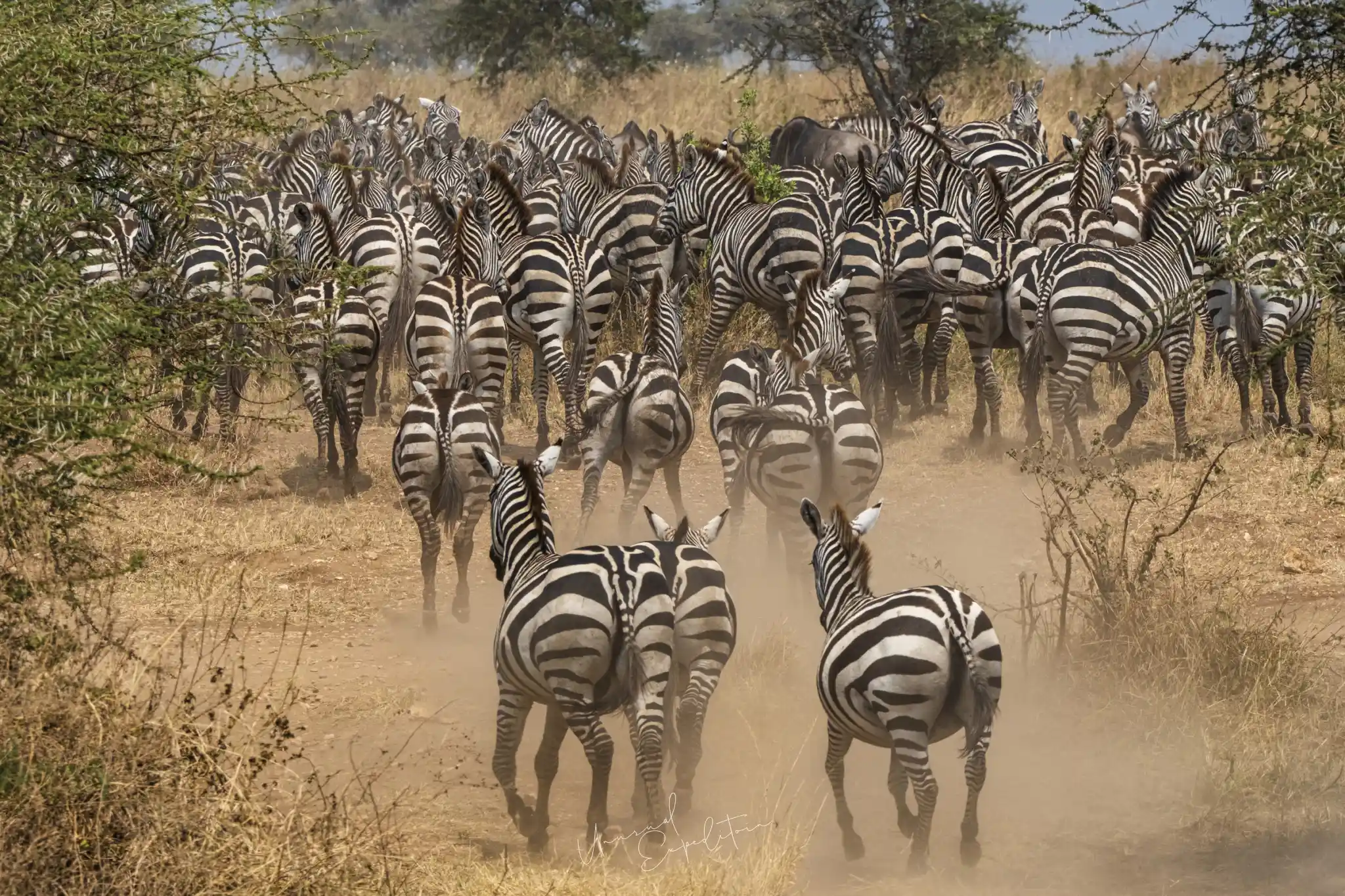
Serengeti National Park zebra are plains zebras, and hundreds of thousands of them move with the wildebeest in the great migration, so you will see them on almost every game drive, in herds, in pairs at the water and running through dust. For photography they are a gift: bold black and white patterns, constant interaction, and a habit of standing still and staring back at the vehicle. The best pictures come from movement in dust, close stripe details, pairs grooming, and zebras mixed with wildebeest in early or late light.
Zebras run through our Serengeti photography tour guide as part of the herds. This destination guide looks at them as a subject in their own right, and how to make them more than a background.
Serengeti national park zebra and the migration
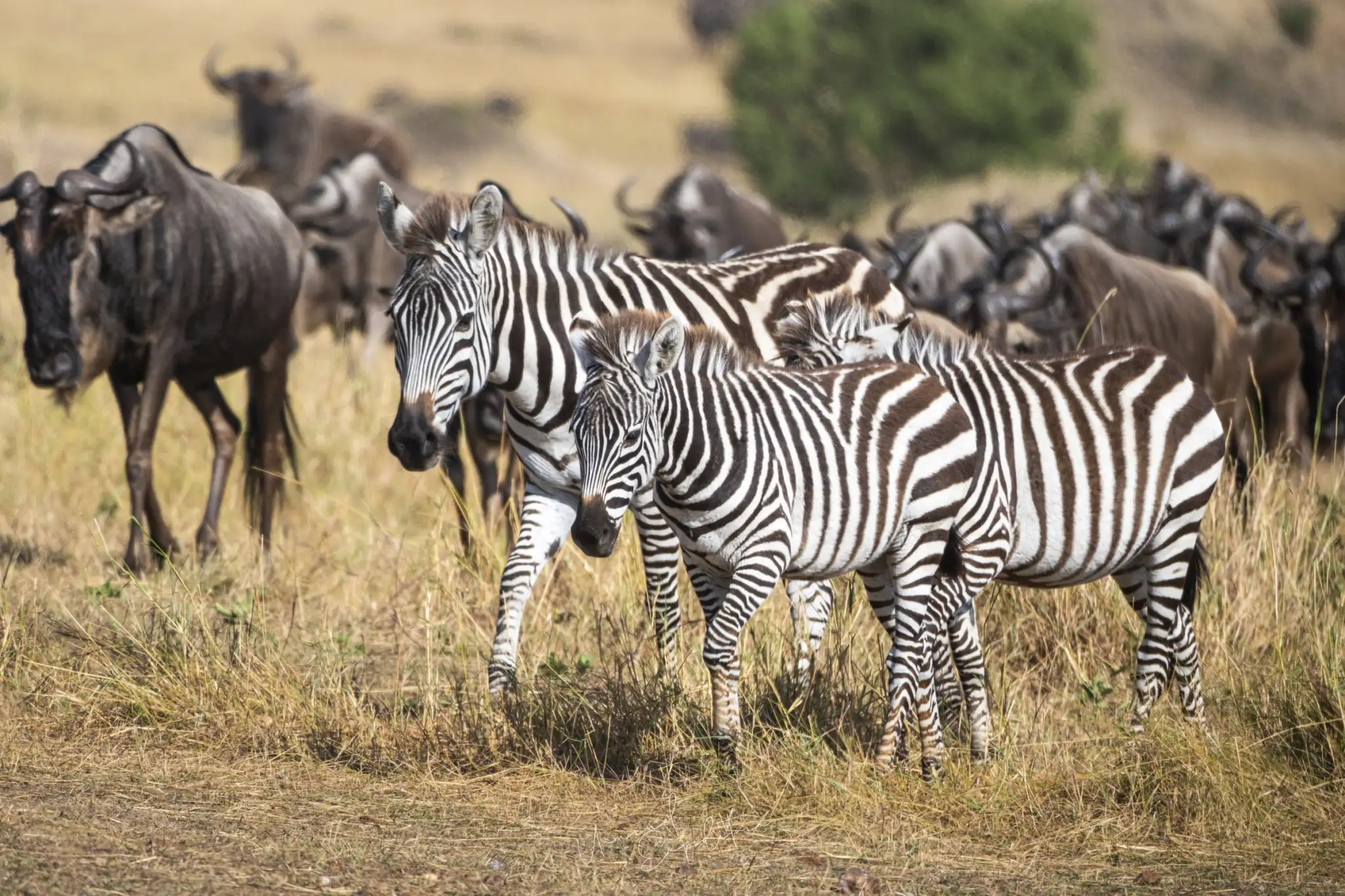
Zebras are the other half of the Serengeti migration. UNESCO's World Heritage listing for Serengeti National Park describes an annual movement of around two million wildebeest together with hundreds of thousands of gazelles and zebras, followed by the predators. The zebras travel in family groups of a stallion with several mares and their foals, which merge into large herds on the move and split up again when they stop. Because the groups stay together, a zebra herd is full of social behaviour: mothers and foals, stallions squaring up, pairs resting their heads on each other's backs. You can find zebras in the Serengeti in any month; their position follows the rain and the grass, so ask your driver guide where the herds are this week.
Why zebras lead the herds
Zebras and wildebeest graze side by side in the Serengeti, but they do not eat in the same way, and that shapes the migration. A study published in Science in 2024 by Anderson and colleagues, summarised by the University of Glasgow, found that the huge wildebeest herds push zebras ahead of them in competition for the best grass, while the wildebeest in turn open up the sward for gazelles following behind. Earlier research in Nature described the same order on the plains: zebra first, then wildebeest, then Thomson's gazelle. For a photographer this means zebras are often at the front edge of the herds and on the longer grass, which gives cleaner backgrounds than the trampled ground behind the wildebeest.
Zebras running through dust
The strongest zebra pictures in the Serengeti are of movement. A herd walking or trotting along a dry track kicks up dust that hangs in the air and softens everything behind the front animals, giving depth and a sense of the crowd. Frame the herd coming towards the vehicle at an angle, with a 100-400mm, and use 1/1000s or faster to freeze the legs. Backlight makes the dust glow, so the late afternoon is the time to look for it. Watch the lead animals: when one zebra starts to run, the others follow, and the shape of the herd changes from a column to a wave. Keep firing as long as the faces stay sharp; the dust behind will do the rest.
Close stripes and details
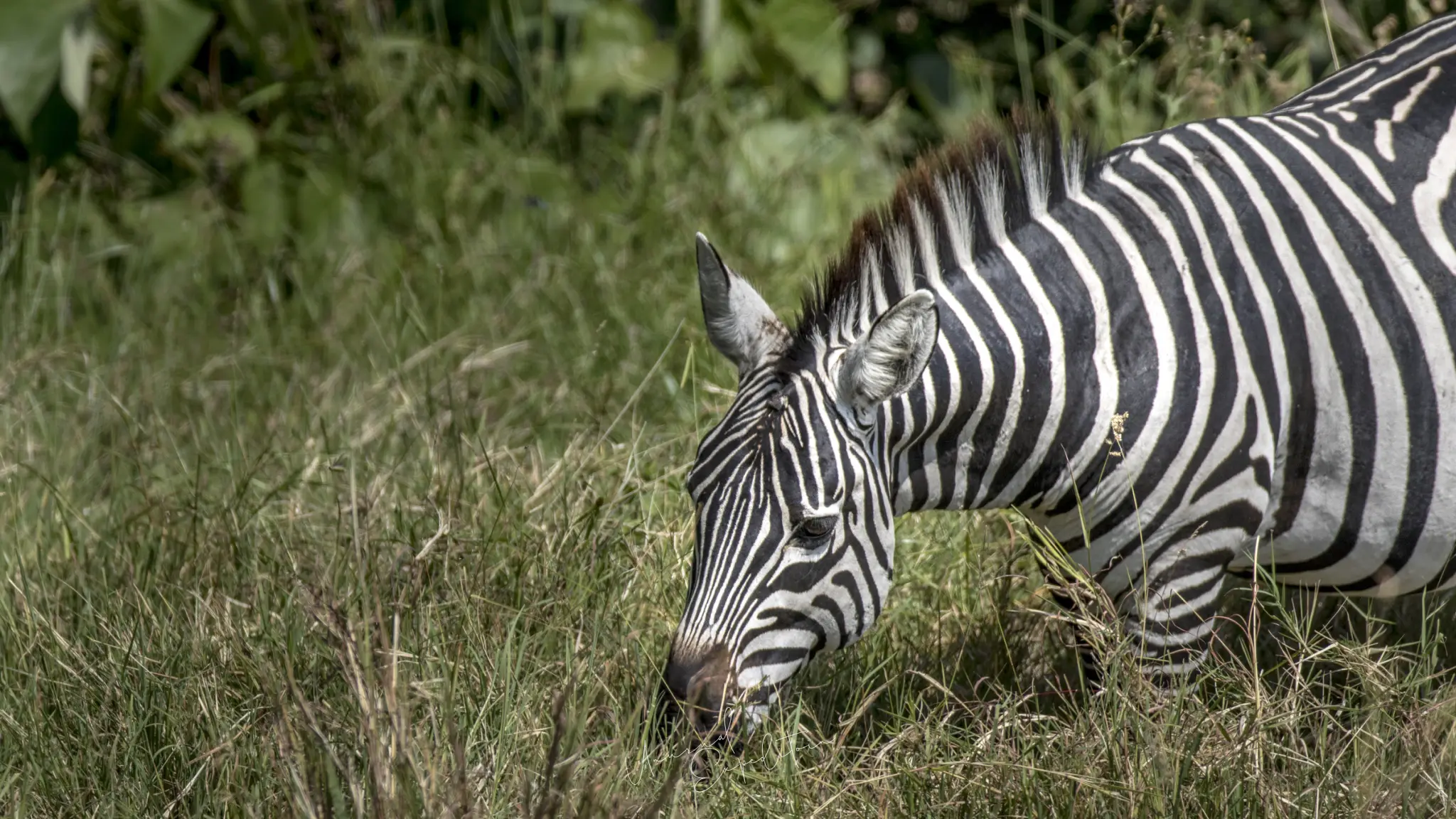
Close details turn Serengeti zebras into pattern pictures. A zebra grazing with its head down, the stripes running across the neck and shoulder, fills a frame with lines; a rump and a swishing tail in tight crop become almost abstract. Stripes are unique to each animal, and the reason for them is still argued about. A 2019 study by Caro and colleagues at the University of Bristol, published in PLOS ONE, found that biting horse flies landed far less often on zebras than on horses, which supports the idea that stripes protect against flies. Use a long lens to isolate the pattern, and expose carefully: in bright sun, the white stripes burn out before the black ones show detail, so pull exposure down until the white holds.
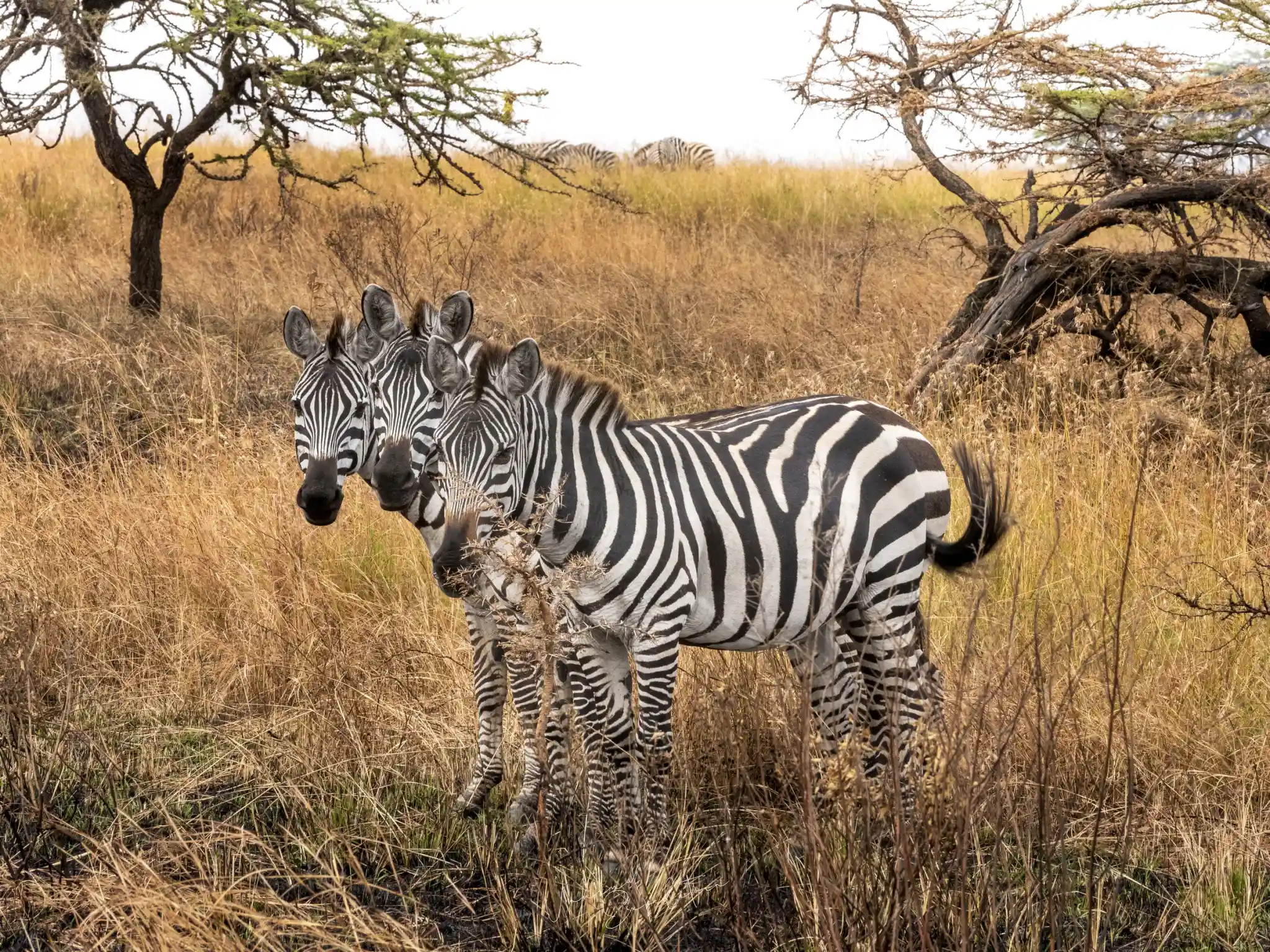
Pairs and portraits
Zebras in the Serengeti often stand in pairs or threes, heads together or one resting its chin on another's back, watching for danger in two directions at once. When a vehicle stops, the whole group may turn to look, which gives a natural portrait with eye contact. Get as low as the vehicle allows, focus on the nearest eye and keep the aperture around f/5.6 to f/8 so both animals are sharp. A dry, gold background with a few thorn trees sets off the black and white better than green. Zebras also groom each other, nibbling at necks and shoulders; that moment is worth waiting for, because it shows the bond within a family group.
Zebras in the landscape
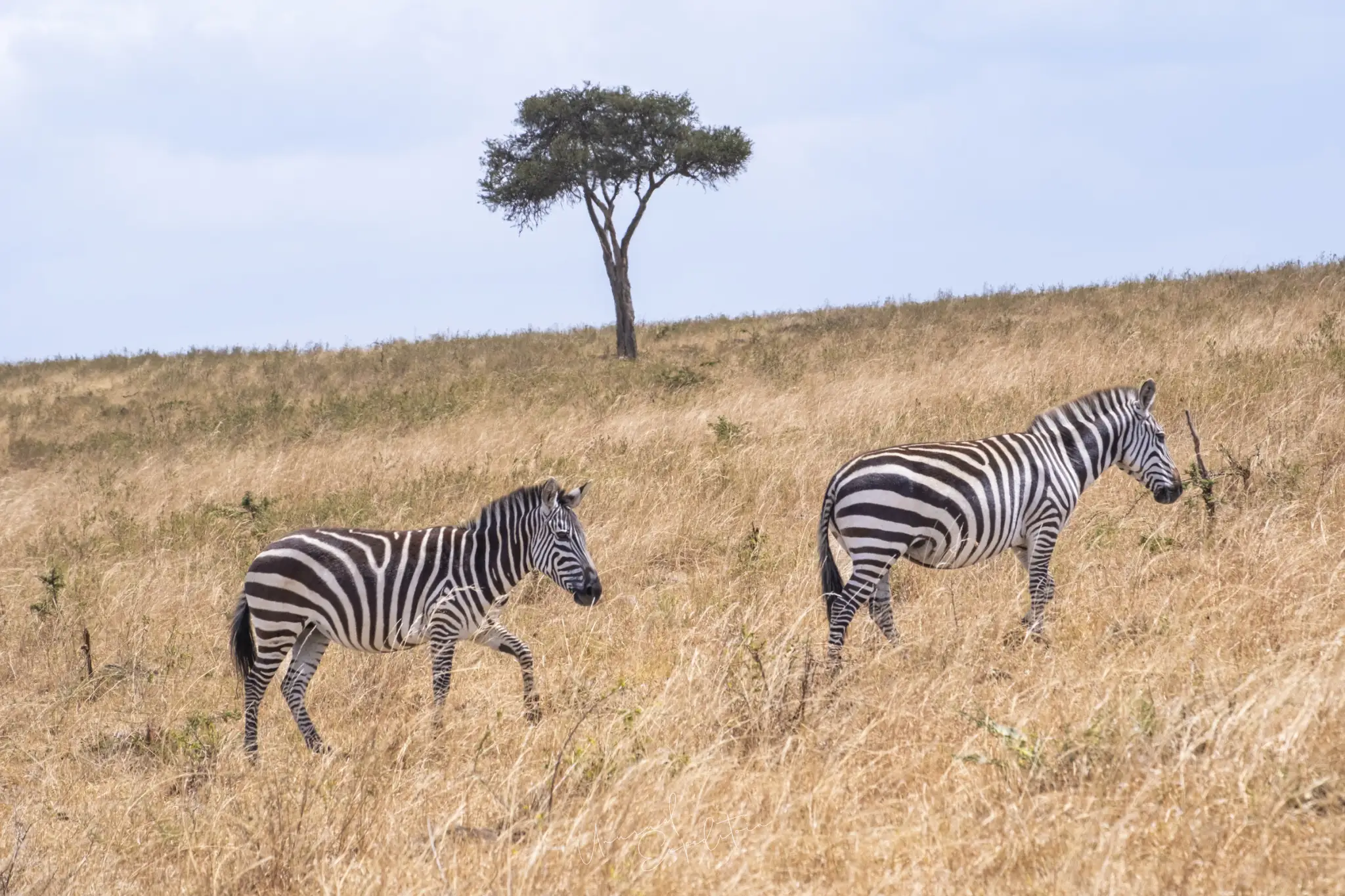
A pair of zebras on a bare slope with one acacia on the skyline is a quieter Serengeti picture, and a good one. Step back to a 70-200mm or even a 24-70mm, keep the horizon low and leave the animals small. The stripes still read from far away, which is not true of most animals. Overcast or hazy skies work here, because the landscape becomes simple and the black and white shapes do the work. These are the frames that hang on walls, more often than the close-ups. For more landscape pictures, see our Serengeti National Park photos.
Zebra pictures to look for
| Picture | Where and when | Lens | Tip |
|---|---|---|---|
| Herd in dust | Dry tracks, late afternoon | 100-400mm | Backlight, 1/1000s or faster |
| Stripe detail | Grazing zebras close to the track | 100-400mm | Pull exposure down for the whites |
| Pair portrait | Anywhere the herd stops | 70-200mm, 100-400mm | Low angle, focus on the near eye |
| Zebras in the landscape | Open slopes, lone trees | 24-70mm, 70-200mm | Horizon low, animals small |
| Zebras with wildebeest | Migration herds | 100-400mm | Find a pattern of stripes against dark backs |
| Zebras drinking | Pools and rivers, midday | 100-400mm | Reflections, splashes on entry |
The table is a checklist for the days when the cats are asleep and the herds are all around you.
People drive past zebras in the Serengeti because there are so many. Then a herd comes down a track in the evening with the dust lit up behind them, and suddenly everyone in the vehicle wants that picture. Zebras are never just background if you wait for the light.
Joseph Mak, tour leader, Unusual Expedition
Zebras at the water
In the dry season Serengeti zebras come to drink at rivers and pools in the middle of the day, nervous and alert because predators wait there too. They approach in a line, hesitate, drink quickly and often bolt back in a splash. Choose a position with the water between you and the herd, set a fast shutter and wait for the first animal to step in. Zebras also join the wildebeest at the Mara River crossings, swimming in family groups; the best time to visit the Serengeti explains when the herds reach the river.
Photograph the herds with us
Our Serengeti Photo Tour 2027 follows the herds at the Mara River and across the park, with time for the quieter subjects between crossings. See the current departure on the Tanzania photography tours page.
Ask us about photographing zebras in the Serengeti
Join the Serengeti photography tour
Serengeti Photo Tour – Tanzania 2027 departs 21 Aug 2027 To 01 Sep 2027. Small group, photography first. All Serengeti photography tours.
Explore Serengeti in depth
- Serengeti Photography Tour: The Complete GuideTanzania
- Serengeti National Park Big Five: Where to Find and Photograph Each OneTanzania
- Serengeti National Park Birds: Bateleurs, Vultures, Hornbills and How to Photograph ThemTanzania
- Serengeti Leopards: Finding and Photographing Them in Seronera and on the KopjesTanzania
- Serengeti Photography FAQ: Fees, Weather, Rules and GearTanzania
- Is the Serengeti Worth Visiting? How to Get There and What to ExpectTanzania
- Serengeti Big Cats: Photographing Leopards, Lions and CheetahsTanzania
- Serengeti Sunrise and Sunset: Photographing the Golden HoursTanzania
- Mara River Crossing in the Serengeti: How to Photograph ItTanzania
- Best Time to Visit the Serengeti for Photography, Month by MonthTanzania
- Serengeti National Park Photos: What the Park Looks LikeTanzania
Upcoming Photo Tours
- Egypt Photo Tour – EgyptEgypt 12 Dec 2026 To 20 Dec 2026
- Inner Mongolia Winter Owl Photo Tour – ChinaChina 01 Jan 2027 To 04 Jan 2027
- Inner Mongolia Winter Photo Tour – ChinaChina 05 Jan 2027 To 11 Jan 2027
- Mekong And Central Highland Vietnam Photo Tour - VietnamVietnam 16 Jan 2027 To 24 Jan 2027