
Antarctica Iceberg and Landscape Photography
How to photograph icebergs and landscape in Antarctica: tabular vs sculpted ice, blue ice in flat light, scale, long lens, March sunsets.
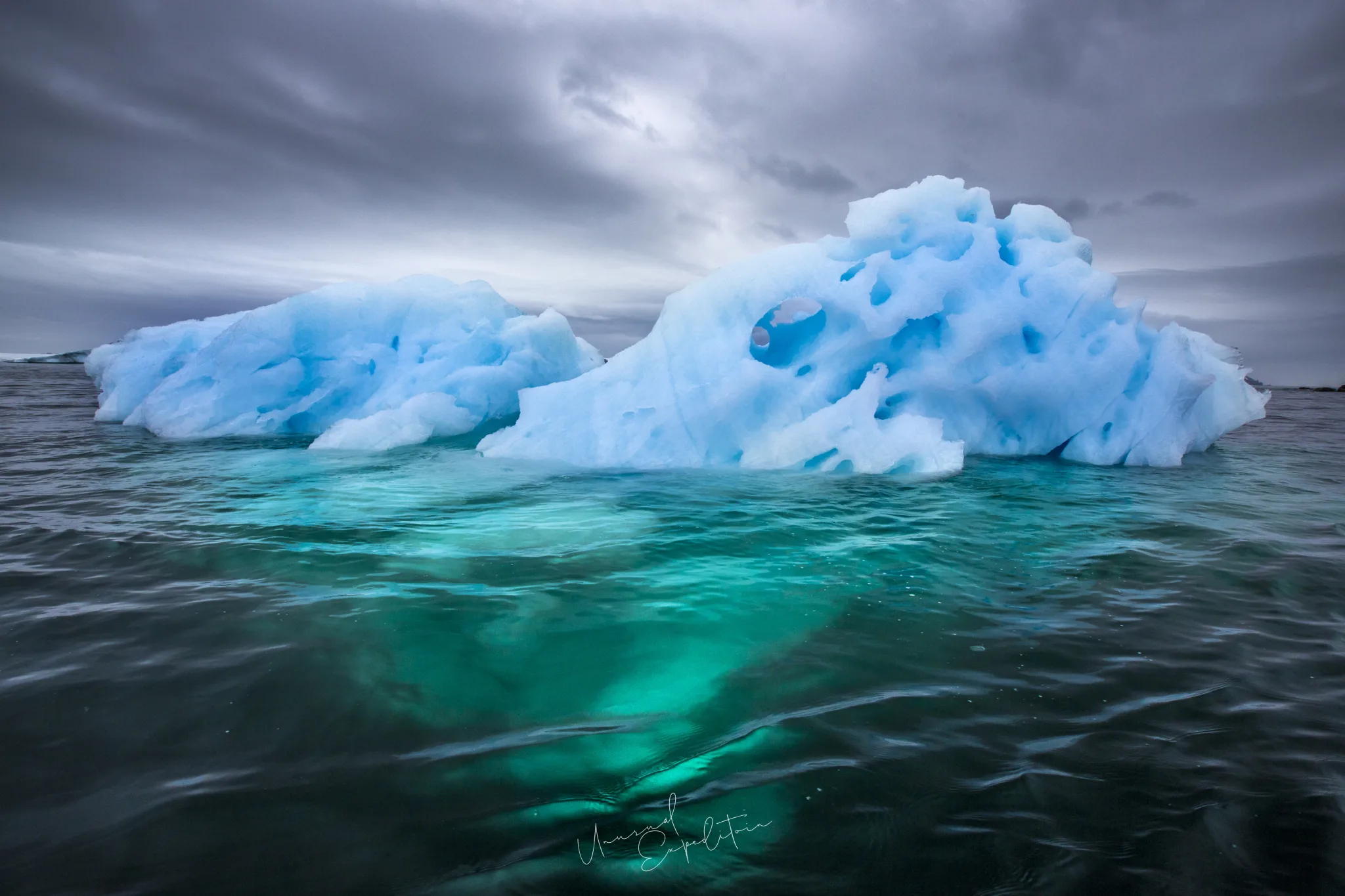
Antarctica iceberg and landscape photography is a problem of scale, light and ice that will not hold still. The bergs of the Antarctic Peninsula range from flat tabular slabs to sculpted towers, their blue reads best under flat cloud, and nothing in the frame says how big they are until a Zodiac or the ship passes in front. In March the sunsets return and the slopes carry pink snow algae. These notes expand the landscape section of our Antarctica photography tour guide.
Where the icebergs are on this route
The fly-cruise reaches two kinds of iceberg water. Around the South Shetland Islands the bergs are travellers, carried north out of the Weddell Sea and the peninsula and grounding in the bays of King George, Livingston and Deception Islands, where they sit for a season and weather into shapes. Along the Antarctic Peninsula itself the ice is local: glaciers calve straight into the Gerlache Strait and into bays such as Neko Harbour and Paradise Harbour, and the Lemaire Channel funnels brash ice and small bergs between cliffs. Which of these the ship reaches is the expedition leader's call on the day, made on ice and weather. Our article on photographing the South Shetland Islands covers the northern half of that water.
Best time to see icebergs in Antarctica
The biggest bergs are an early season sight. In November the winter's ice is still breaking out and tabular giants drift in the straits with pristine snow on top. By March the largest have broken down or drifted north, and what remains is more interesting to a camera: weathered, undercut, arched ice with the blue core exposed. March also brings the first new sea ice in sheltered bays, which can close a landing but gives mirror-flat grey water with bergs frozen into it. The light is the other difference. Midsummer has no true sunset; mid March has about thirteen hours of daylight and real sunrises and sunsets with long twilights, which is when ice photographs best. For the full season, see the best time to visit Antarctica for photography.
Tabular, sculpted and the small stuff
| Ice type | What it is | How to photograph it |
|---|---|---|
| Tabular iceberg | Flat-topped slab broken from an ice shelf, often kilometres long | Wide lens from the deck with the ship's wake or a Zodiac for scale; the long straight edge against a mountain |
| Sculpted iceberg | Weathered and rolled berg with arches, caves and ridges | Long lens for one detail at a time; flat light for the blue; circle it in the Zodiac for the best face |
| Bergy bit and growler | Fragments standing a few metres or less above the water | Foreground from water level with a berg or glacier behind; reflections on still mornings |
| Brash ice | Floating rubble from calving, a crust on the bay | Texture and pattern from above at the ship's rail; a leading line for the Zodiac |
| Glacier front | The calving face of a tidewater glacier | Compressed with a 100-400mm from a safe distance; include the scale of a Zodiac the driver has stopped well back |
The United States National Ice Center and the NSIDC class an iceberg as standing more than five metres above the water, a bergy bit between one and five, and a growler under a metre, which is a useful reminder that most of what you will frame from a Zodiac is not technically an iceberg at all.
Why blue ice looks best in flat light
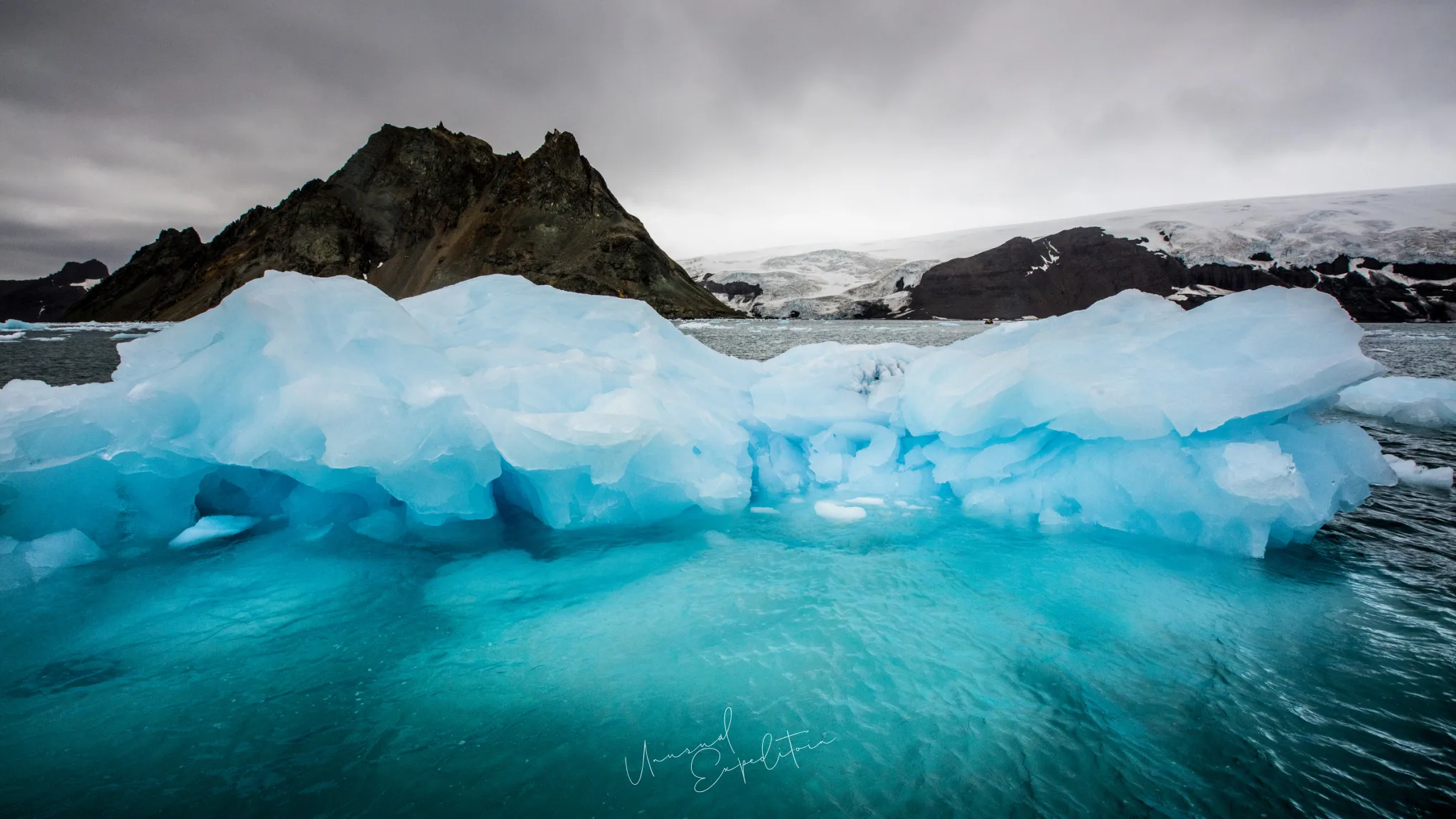
The blue inside an iceberg is dense old ice that has had the air squeezed out of it, and it absorbs red light so that what comes back is blue. Direct sun bounces off the wet surface and washes that colour to white; a grey sky lets the surface go quiet and the interior glow through. Overcast days, which make up most of an Antarctic trip, are the good days for iceberg photography. Expose for the ice, not the sky, and watch the right edge of the histogram; a circular polariser cuts surface glare and shows the blue continuing below the waterline. The deepest blue is usually in a recently rolled berg, where the underside has come up, or in the undercut of an arch. Our Antarctica photography tips for snow and ice exposure cover the settings in detail.
Scale: the ship, the Zodiac, a penguin
An iceberg the size of an office block photographs like an ice cube unless something known sits beside it. Antarctic landscape photography is largely the hunt for that reference. From the deck, wait for a Zodiac to cross in front of the berg; from the Zodiac, wait for the ship to appear behind it; on a beach, a line of gentoos walking past grounded ice does the job at the small end. When there is no reference at all, go the other way and make the picture about form: a long lens on one face of a sculpted berg, with no horizon and no sky, so the frame stops pretending to be a landscape and becomes a study of ice.
"At the end of my December 2019 voyage I went through the group's icebergs and most people had the same wide frame of the same berg, forty times. The pictures that stood out were the ones where someone had turned the long lens on a single arch and waited for the Zodiac to come round behind it. Shoot the detail of one berg, not only the whole bay."
Joseph Mak, tour leader, Unusual Expedition
The long lens for iceberg detail
A 70-200mm or 100-400mm is the lens most people leave in the bag for landscape and the one that makes the strongest ice pictures. From the ship it compresses a line of bergs against a glacier wall so that the layering reads. From the Zodiac it isolates one face: the melt channels, the blue vein, the band of old sediment, the arch with light coming through. It also keeps a safe distance, because tall bergs roll and Zodiac drivers stay well away from them. Shoot handheld at 1/500 s or faster from a moving boat, stabilisation on. A tabular berg's straight edge against the sea at 400mm, with a single cape petrel in front of it, is a frame that says Antarctica with nothing else in it.
Reflections and still water
Paradise Harbour and the Lemaire Channel are the places people name for reflections, and on a windless morning the water in both is like glass, with the mountains and ice doubled. Those mornings happen early, and on my four midsummer voyages the stillest water was always in the first hours after breakfast before the wind came up. Be on deck. Compose with the horizon central when the reflection is perfect and off-centre when ripples break it, and expose for the real ice, not the mirrored one, which is always darker. If the ship is moving slowly, the bow wave ruins the mirror ahead; move aft and shoot across the beam where the water is still undisturbed.
Calving glaciers and how close you get
Neko Harbour is known for its calving glacier, and the sound of a face letting go across a bay is one of the things people remember. Photographing it is a matter of patience and distance. Expedition teams keep Zodiacs and landing parties well back from active fronts because a calving sends a wave, and IAATO's site guidelines reinforce that; the long lens does the rest. Set a fast shutter, pre-focus on the face, and wait, because calving gives no warning beyond a crack. Most of the time nothing happens, and the picture you take home is the face itself: blue crevasses, the dirty band at the base, the arc of brash below it.
March sunsets and snow algae
Two things the late season adds to Antarctic landscape photography. The first is the sunset. Mid March brings the sun down in mid evening with a long twilight, and ice takes colour better than anything else on earth: pink, then violet, then a cold blue that lasts an hour. A tripod on deck at anchor earns its weight here. The second is the snow algae. By late summer the slopes above many colonies carry pink and green blooms, recorded in published surveys of the peninsula, a band of unexpected colour between grey rock and white ridge. Expose for the snow, not the algae, which is darker than it looks. Both of these are absent in December, which is part of why we chose March for our departure.
Stand on the deck with us in March
Ice is the subject that brought me back to Antarctica four times, and the fly-cruise gives six nights of it in the late-season light that my midsummer voyages never had. Join our Antarctica photography tour and look for me at the rail before the wind gets up; the glowing berg in the dark bay is what I will be after.
Join the Antarctica photography tour
Antarctica Express Air-Cruise 2028 - Antarctica departs 10 Mar 2028 To 16 Mar 2028. Small group, photography first. All Antarctica photography tours.
Explore Antarctica in depth
- The Complete Guide to an Antarctica Photography TourAntarctica
- King George Island: Weather by Month, Daylight Hours and PenguinsAntarctica
- Sunset in Antarctica: Does the Sun Set, and What the Light DoesAntarctica
- Antarctica Photos: What It Really Looks Like from an Expedition ShipAntarctica
- What to Pack for an Antarctica Cruise (and the 25 kg Rule)Antarctica
- Photographing the South Shetland IslandsAntarctica
- King George Island, Antarctica: The Airstrip, the Bases and the ChurchAntarctica
- Is Antarctica Worth Visiting? A Photographer's ViewAntarctica
- Crossing the Drake Passage: What to ExpectAntarctica
- Cape Horn and the Beagle Channel: Photographing the End of the WorldAntarctica
- Camera Gear for Antarctica PhotographyAntarctica
- The Best Time to Visit Antarctica for PhotographyAntarctica
Upcoming Photo Tours
- Egypt Photo Tour – EgyptEgypt 12 Dec 2026 To 20 Dec 2026
- Inner Mongolia Winter Owl Photo Tour – ChinaChina 01 Jan 2027 To 04 Jan 2027
- Inner Mongolia Winter Photo Tour – ChinaChina 05 Jan 2027 To 11 Jan 2027
- Mekong And Central Highland Vietnam Photo Tour - VietnamVietnam 16 Jan 2027 To 24 Jan 2027