
Photographing Penguins in Antarctica
Gentoo, chinstrap and Adelie penguins on the peninsula route: where each lives, what March brings, the 5 metre rule and shutter speeds.
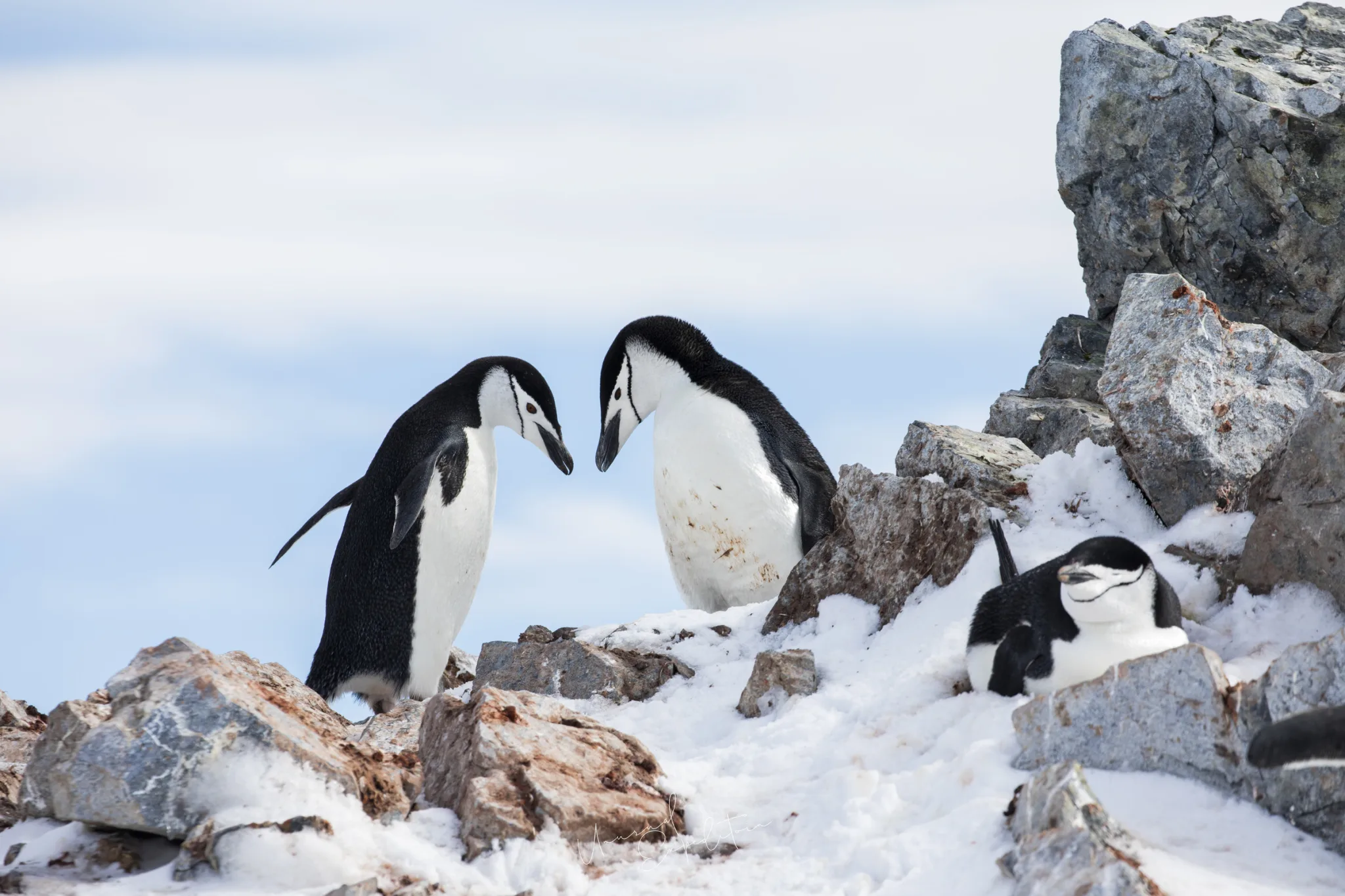
Photographing penguins in Antarctica on the peninsula route means three species: gentoo, chinstrap and Adelie. Emperor and king penguins are not on this route, and no small-ship voyage to the Antarctic Peninsula will show you either. What the peninsula gives in March is fledging chicks, moulting adults standing scruffy and still, and food chases through the colony, all photographed from your knees at eye level, 5 metres away, with a shutter speed fast enough to freeze a bird coming out of the water.
Penguins are the subject most people book for, and the complete guide to an Antarctica photography tour puts them in the context of the whole voyage. Here is the species detail: which penguins live where, what late season does to the colonies, how close you may go, and the camera settings that work from a beach and from a moving Zodiac.
Antarctica types of penguins on the peninsula route
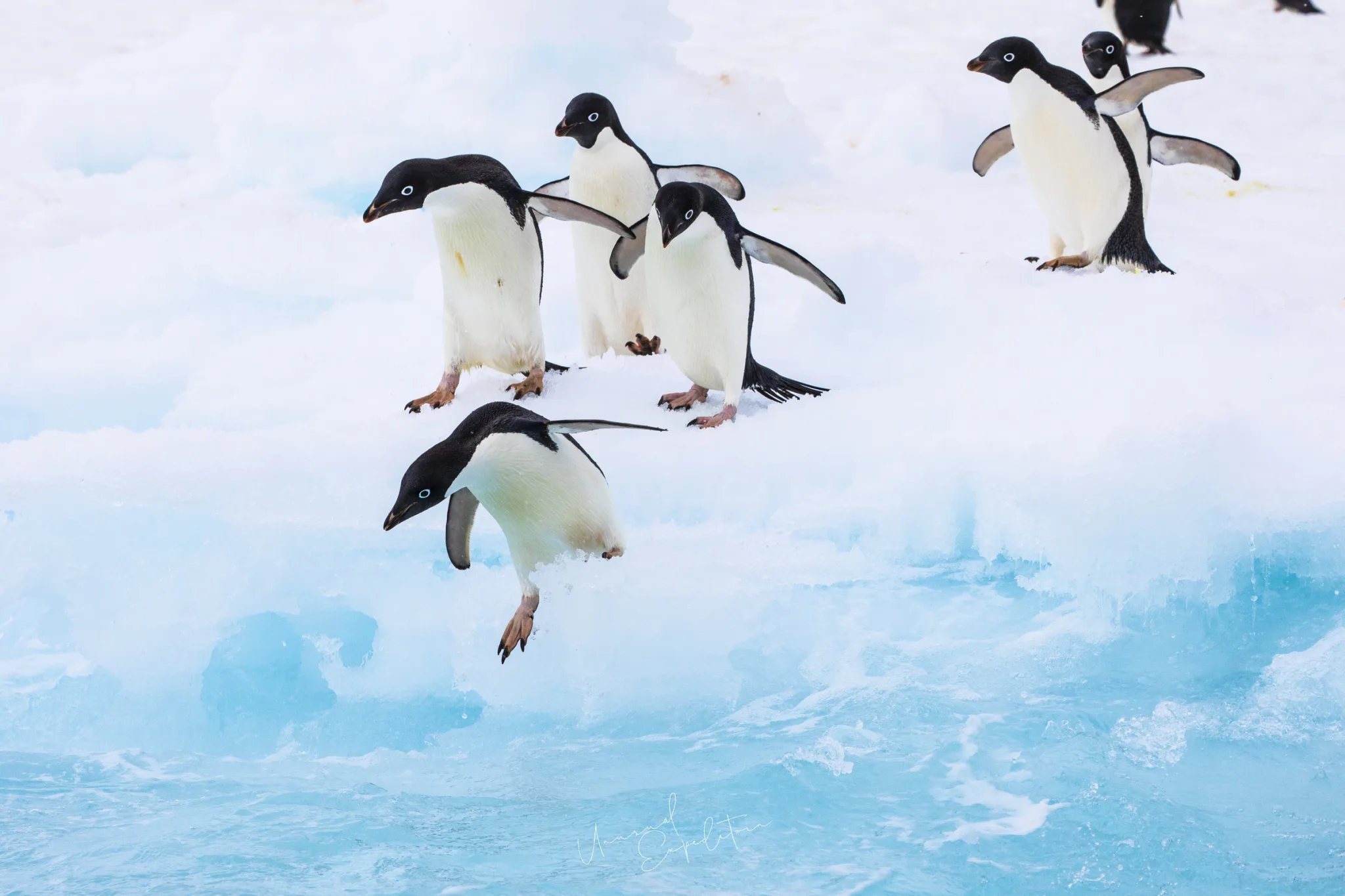
Three penguin species breed on the Antarctic Peninsula and the South Shetland Islands, and all three are brush-tailed penguins of the same genus. The gentoo is the largest of the three, with a white patch over each eye and a bright orange-red bill; it nests on low ground near the shore and has been spreading south along the peninsula. The chinstrap is named for the thin black line under its chin, nests on steep rocky slopes often high above the landing, and forms the biggest and loudest colonies on the route, at Half Moon Island and Baily Head among others. The Adelie is the small black-headed bird with the white eye ring and is the most truly Antarctic of the three, favouring colder sites further south. Which species you photograph most depends on which landings the ship makes, and that depends on ice and weather.
| Species | Field mark | Where it nests | In March |
|---|---|---|---|
| Gentoo | White eye patch, orange-red bill | Low ground near the shore, peninsula and South Shetlands | Chicks dispersing from late February; colonies still busy; adults moulting |
| Chinstrap | Thin black line under the chin | Steep rocky slopes, South Shetlands especially | Chicks fledging late February into March; adults moulting |
| Adelie | Black head, white eye ring | Colder sites further south | Colonies largely emptied by late February |
In March, go for gentoos and chinstraps and treat an Adelie as a bonus.
Emperor and king penguins are not on this route
This needs saying plainly because the pictures people carry in their heads are often of emperors on sea ice or of king penguins in their thousands. Emperor penguins breed on fast ice around the Antarctic continent, far from the peninsula waters a small expedition ship works, and seeing them requires a different and much more expensive kind of trip. King penguins breed on sub-Antarctic islands such as South Georgia and the Falklands, which are not on a peninsula fly-cruise. On the Antarctica Express Air-Cruise you will photograph gentoo, chinstrap and Adelie penguins and no other species. If a king or emperor is the bird you must have, this is not the trip, and I would say so before you book. If you can be happy with three species seen close, at eye level, in the last light of the season, read on.
How to see penguins in Antarctica
You see penguins in Antarctica by landing at a colony from a Zodiac, by cruising past them in the Zodiac, and from the ship as they porpoise through the water alongside. Landings are run under IAATO rules: no more than 100 visitors ashore at one site at a time, a guide for every 20 guests, flagged routes that keep people off the penguin highways between colony and sea, and at least 5 metres from any bird, more if it reacts. Nobody needs a permit of their own; the operator holds the permits and the national authorisations. The birds have no land predators and do not flee people, so if you sit still a penguin will often walk up to you, which is allowed; you may not walk up to it. Boots are biosecurity-checked before every landing, and nothing is left behind. Time at a colony is limited by the landing schedule, so decide early what the picture is. The Antarctica trip FAQ answers the permission and access questions in more detail.
Where to see penguins in Antarctica
Where to see penguins in Antarctica depends on the species. Gentoos are the easiest, breeding on low ground near the beaches all along the western Antarctic Peninsula and through the South Shetland Islands, including the shores of King George Island where fly-cruise guests first land. Chinstraps hold the big colonies of the South Shetlands, at Half Moon Island and at Baily Head on Deception Island among others, often on steep rock high above the landing. Adelies favour colder sites further south along the peninsula and are the ones most likely to be missed late in the season. Which colonies you reach is decided by ice and weather on the day, not by the brochure, and a small ship with Zodiacs reaches more of them than a large one. Emperor and king penguins are not on this route at all, as the section above explains.
Can you see penguins on a fly cruise
Yes, and in practice as many as on a ship-only voyage, because the days saved by flying over the Drake Passage are spent among the islands and the peninsula where the colonies are. The fly-cruise lands first on King George Island, which has gentoo, chinstrap and Adelie colonies of its own, then works the South Shetlands and the peninsula coast with landings and Zodiac cruises as conditions allow. The fly-cruise explainer describes the shape of the trip. What a fly-cruise cannot promise, and neither can any voyage, is a particular colony on a particular day; the expedition team chooses each landing on the morning's ice and wind.
Best time to see penguins in Antarctica
The best time to see penguins in Antarctica depends on what you want from them. The season runs late October to late March. November gives courtship, nest building and eggs on clean snow. December and January give hatching and small downy chicks under 24-hour light. Late February into March, our window, gives fledglings nearly as big as their parents, chases as chicks pester adults for food, and adults in moult, which takes about three weeks and leaves them standing still, scruffy and unable to swim. The colonies are muddier than in December, the Adelie sites are largely empty, and some gentoo colonies have thinned while others are still busy. In exchange you get real sunsets and low golden light on the birds for the first time since spring, which the midsummer months do not have. The best time to visit Antarctica for photography weighs these trade-offs across the season.
What March does to a penguin colony
A March penguin colony is a different place from the orderly rows of nesting birds in December. Gentoo chicks have left the nest and gather in groups near the shore, learning to swim and losing the last of their down in untidy patches. Chinstrap chicks are fledging, going to sea for the first time. Adults in moult stand motionless for days, feathers lifting off in clumps, which is a gift for a portrait because the bird does not move and a slow approach to 5 metres is simple. The chases are the action pictures: a grown chick running after an adult, flippers out, both birds skidding on wet rock. Snow algae stains the slopes pink and green behind the colony. The ground is wet and the light is lower. I expect the late-season colony to be more interesting to photograph, because the birds are doing things, not sitting on eggs.
Eye level from your knees
The single biggest improvement anyone can make to a penguin photograph is to get the camera down to the bird's eye. Standing, you shoot down onto the back of a bird against grey mud. Kneeling in the snow, the bird stands against sky or distant ice, the eye catches light, and the frame has depth. Kneel only where the guides say kneeling does no harm, never where it blocks a penguin highway or crowds a nesting bird, and stay the 5 metres. Waterproof trousers make this painless. A 70-200mm lens at 5 metres gives a full-body portrait of a gentoo; a 100-400mm lens frames the head. Expose for the white breast: +1 to +2 EV over the camera's reading, check the histogram, and keep the whites white without clipping. Two chinstraps greeting each other, heads back, photographed from the knees at the moment the beaks open, is the picture I go back for every voyage.
Shutter speeds for penguins
Penguins are slow on land and very fast in the water, and the shutter speed follows. For a standing or walking bird 1/500 s is plenty and lets you keep ISO low. For chases through the colony use 1/1000 s and continuous autofocus. For penguins porpoising or leaping out of the water onto ice or rock, especially from a moving Zodiac, go to 1/2000 s or faster and let the ISO rise; a sharp frame at high ISO is worth more than a soft one at low ISO. Set the camera before the bird appears; the leap lasts a fraction of a second. In flat light a 70-200mm lens at a wide aperture handles most of this; the 100-400mm lens is for birds on the far side of a channel. The gear list and why the 25 kg flight baggage limit shapes it are in camera gear for Antarctica photography.
"On one of my midsummer voyages a gentoo walked up to me while I was lying in the snow and stood looking at the lens from about two metres, closer than I was allowed to go to it. I did not move. It is the only time I have been out-stared by a bird, and the frame is useless because the lens could not focus that close. The rule is 5 metres for us, not for them."
Joseph Mak, tour leader, Unusual Expedition
Photograph the last penguins of the season with us
Gentoos and chinstraps in moult, fledglings learning the sea, and low March light on a colony are what our fly-cruise is built around. The Antarctica photography tour page has the current departure and how to book. I will be in the Zodiac with you, and on the beach, kneeling.
Join the Antarctica photography tour
Antarctica Express Air-Cruise 2028 - Antarctica departs 10 Mar 2028 To 16 Mar 2028. Small group, photography first. All Antarctica photography tours.
Explore Antarctica in depth
- The Complete Guide to an Antarctica Photography TourAntarctica
- King George Island: Weather by Month, Daylight Hours and PenguinsAntarctica
- Sunset in Antarctica: Does the Sun Set, and What the Light DoesAntarctica
- Antarctica Photos: What It Really Looks Like from an Expedition ShipAntarctica
- What to Pack for an Antarctica Cruise (and the 25 kg Rule)Antarctica
- Photographing the South Shetland IslandsAntarctica
- King George Island, Antarctica: The Airstrip, the Bases and the ChurchAntarctica
- Is Antarctica Worth Visiting? A Photographer's ViewAntarctica
- Crossing the Drake Passage: What to ExpectAntarctica
- Cape Horn and the Beagle Channel: Photographing the End of the WorldAntarctica
- Camera Gear for Antarctica PhotographyAntarctica
- The Best Time to Visit Antarctica for PhotographyAntarctica
Upcoming Photo Tours
- Egypt Photo Tour – EgyptEgypt 12 Dec 2026 To 20 Dec 2026
- Inner Mongolia Winter Owl Photo Tour – ChinaChina 01 Jan 2027 To 04 Jan 2027
- Inner Mongolia Winter Photo Tour – ChinaChina 05 Jan 2027 To 11 Jan 2027
- Mekong And Central Highland Vietnam Photo Tour - VietnamVietnam 16 Jan 2027 To 24 Jan 2027