
Photographing Whales in Antarctica
Why March is whale season in Antarctica, humpback, minke and orca behaviour, shooting from ship and Zodiac, lens and shutter settings.
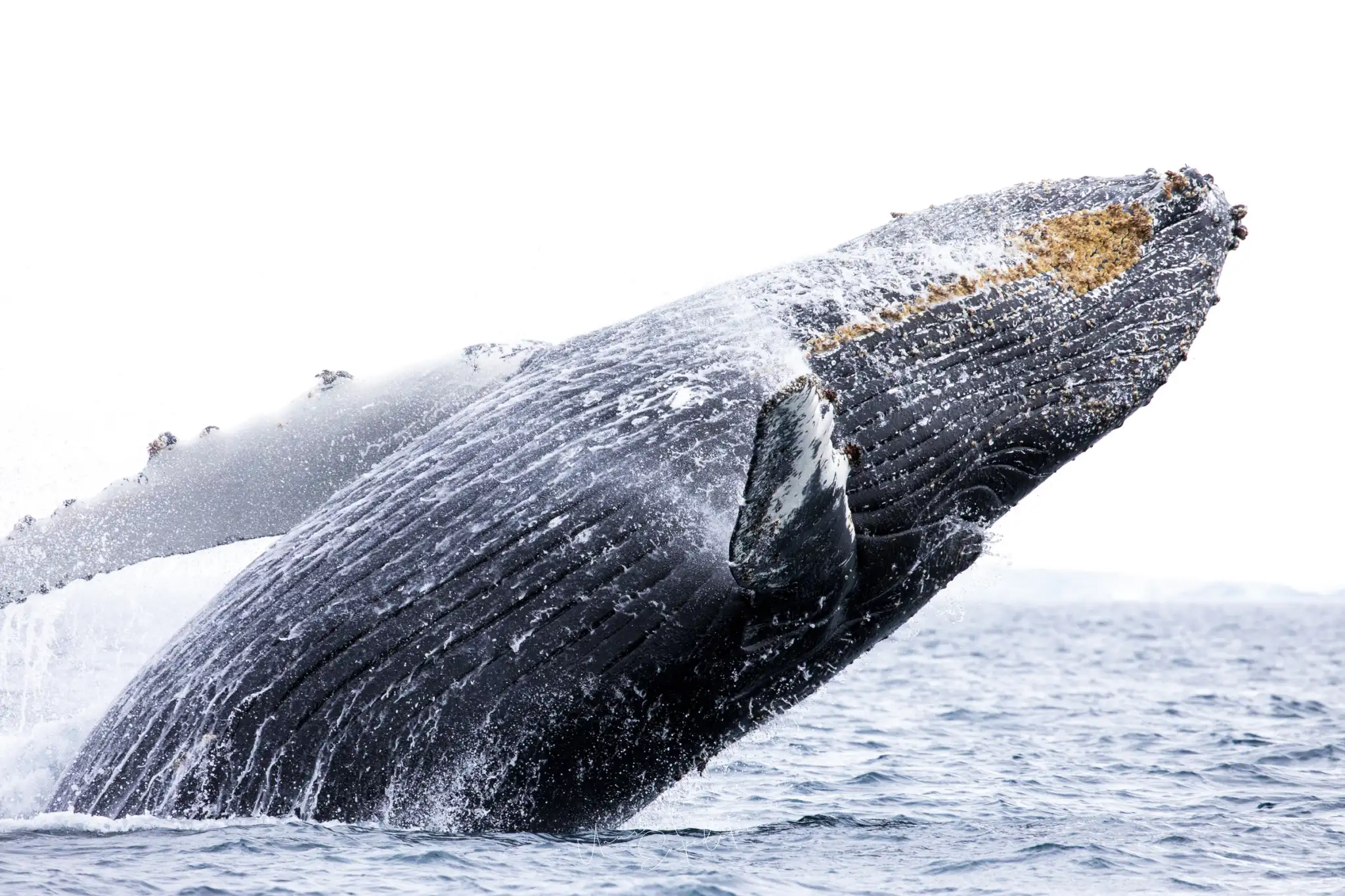
Photographing whales in Antarctica means humpbacks first, minke whales second and orca when you are lucky, and the best time to see whales in Antarctica is the end of the season, late February and March, when a summer of krill feeding has left them numerous, well fed and relaxed around ships. You photograph them from the deck with a long lens and from a stationary Zodiac with a shorter one, at fast shutter speeds, and you accept that no whale is ever guaranteed.
Whales are the main reason our departure sits in March, and the complete guide to an Antarctica photography tour explains how that choice shapes the whole voyage. Here is the species detail, why late season is whale season, what feeding behaviour to expect, how shooting from the ship differs from the Zodiac, and the lens and shutter settings that give you a sharp fluke.
Best time to see whales in Antarctica
The best time to see whales in Antarctica is late in the season. The tourist season runs from late October to late March, and whale numbers build through it. In November there are few whales; the humpbacks are still arriving from their breeding grounds and the krill blooms have not peaked. By January feeding is in full swing, and by late February and March the whales have been eating for months, are at their most numerous in the bays and straits of the peninsula, and behave as if ships do not exist. That is the window we chose after four midsummer voyages, during which whales were a highlight but never the daily event that late-season visitors describe. Fewer ships work the peninsula in March as well. The price is shorter days and the chance of early pack ice closing a bay. Antarctica photography season, month by month lays the trade-offs out in a table.
Which whales live around the Antarctic Peninsula
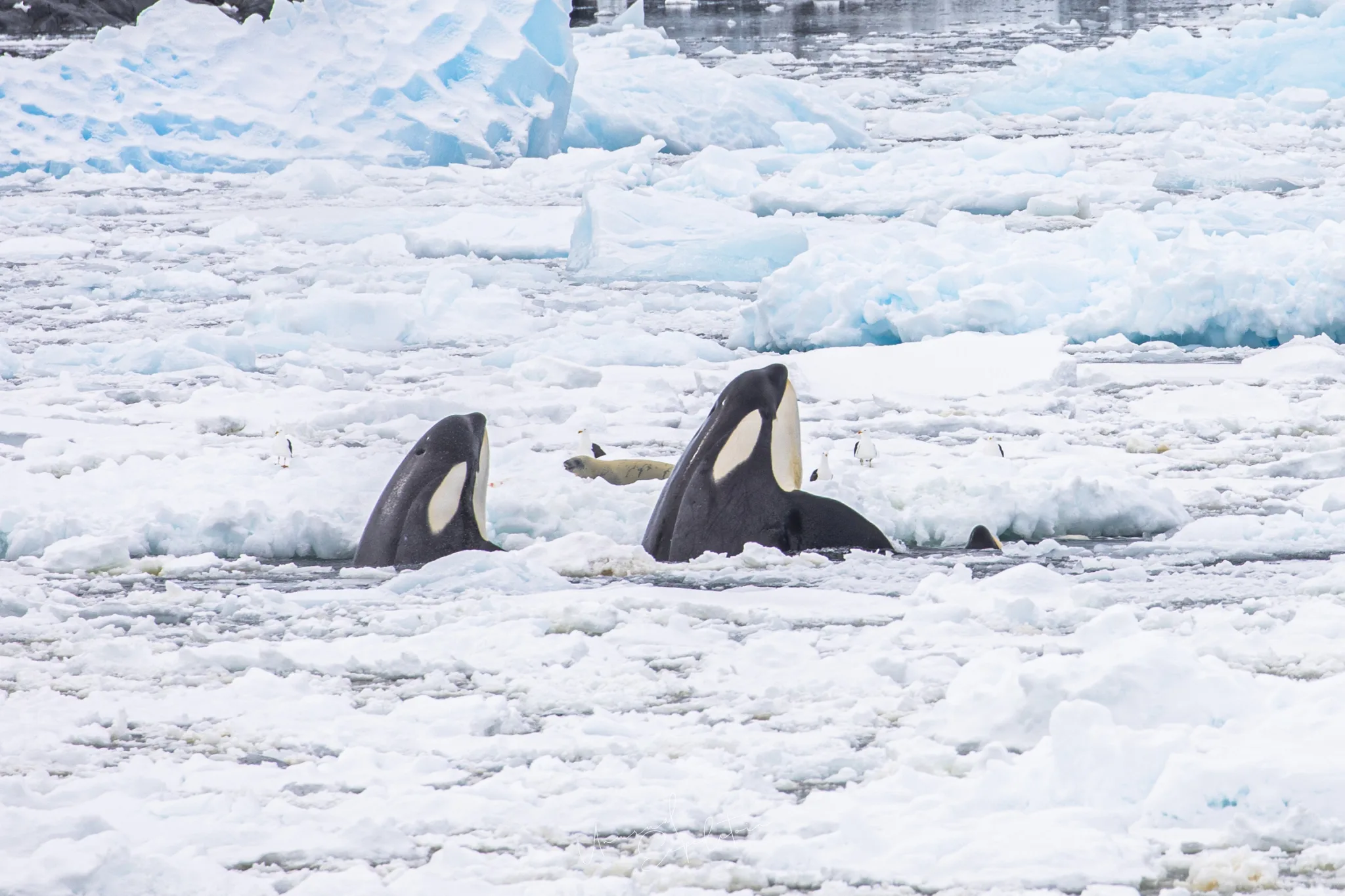
Three whales are realistic subjects on the peninsula route and two more are possible. Humpback whales are the stars: large, slow at the surface, with a high arching back, a small dorsal fin and a fluke they lift clear of the water before a deep dive, each tail marked differently underneath. Antarctic minke whales are smaller and faster, show a sharp dorsal fin and a sleek back, and rarely fluke; they are common but harder to photograph well. Orca pass through the Gerlache Strait and the surrounding waters in family groups, with the tall black fin of a male unmistakable at distance. Fin whales and blue whales are possible in open water, on the Drake crossing or the Bransfield Strait, but seeing one is luck, not planning. The humpback is the one that usually shows up.
| Whale | What you see at the surface | Where on the route | Typical lens from the ship |
|---|---|---|---|
| Humpback | Arching back, small fin, lifted fluke, blow | Peninsula bays and straits, Gerlache and Bransfield | 100-400mm |
| Antarctic minke | Sleek back, sharp fin, fast surfacing, no fluke | Bays and among the ice | 100-400mm |
| Orca | Tall black fin, white eye patch, family groups | Gerlache Strait area, open water | 100-400mm |
| Fin and blue | Tall blow, long back | Open water, Drake Passage | 100-400mm |
The lens column is the same for every whale because from a ship's deck you are always farther from the animal than you want to be.
What feeding behaviour to expect in March
Bubble-net feeding, where a group of humpbacks blows a ring of bubbles to trap krill and then surfaces through it together, happens on the Antarctic Peninsula but is most frequent in January. In March expect lunge feeding, where a single humpback drives up through a krill swarm with its mouth open and its throat ballooning; logging, where whales rest motionless at the surface like floating logs, sometimes for a long time; tail slaps; and close approaches to stationary Zodiacs, where a curious whale circles or passes under the boat. Logging whales are the easiest to photograph because they do not move, and you have time to compose them against ice or mountain. Lunges come without warning; the only preparation is to have the camera up and the shutter speed set. A whale that approaches a Zodiac is an event the driver manages; the engine goes off and everyone stays seated.
Photographing whales from the ship
From the ship you have height, stability and a clear horizon, and you have distance. The bridge announces sightings and the ship slows or stops; the whales do what they want. A 100-400mm lens is the working lens on deck, with a 70-200mm lens on a second body if you carry one, because a whale can surface close to the hull as easily as far off. Shoot from the lower open decks where possible, since the lower you are the more the whale and its background compress into one picture. Use the rail as a brace or carry a beanbag; a monopod on a moving deck is less steady than a well-braced elbow. The light on the water is the exposure trap: a dark whale against bright sea reads as underexposed, so check the histogram and let the water go light to hold detail in the back. Watch the blow first; the body follows the direction of the blow, and the fluke comes after the back arches higher than usual.
Photographing whales from a Zodiac
From a Zodiac you are at water level and a humpback that surfaces close is an experience as much as a photograph. IAATO rules put the responsibility on the driver to keep a respectful distance and to stop the engine when a whale approaches, and the Zodiac does not chase. A 24-70mm lens is often the right choice here because the whale can fill a wide frame, with a 70-200mm lens for flukes further off. The boat moves, the whale moves, and your shutter speed carries the picture: 1/2000 s or faster with the ISO left to rise, continuous autofocus, and a burst through the surfacing. Keep the camera on a short strap and a cloth in reach for spray. The best Zodiac whale pictures include the ice or the mountain behind the whale for scale; a fluke alone against water could be anywhere. Shooting technique from a moving Zodiac, for whales and penguins alike, is covered in our Antarctica photography tips on exposure and Zodiac shooting.
Lens and shutter settings that work
The settings for whales do not change much; the discipline is in holding them. Shutter speed 1/2000 s for anything moving, 1/1000 s for a logging whale, which gives you room to drop the ISO. Continuous autofocus with a wide zone, because the whale appears where you did not expect it. Aperture wide or one stop down. Exposure +1/3 to +2/3 EV when the water is bright, checked on the histogram, and more where ice is in the frame. A 100-400mm lens from the deck, a 24-70mm lens or 70-200mm lens in the Zodiac. Batteries drain fast in the cold, so carry more than seems sane and warm the spare in an inside pocket. Seal the camera in a bag before going from the cold deck into the warm cabin, or condensation will end the session. What to carry, and how the 25 kg flight limit shapes it, is in camera gear for Antarctica photography.
"On one of my midsummer voyages a humpback logged beside the ship in the Gerlache Strait for long enough that I changed lenses twice and still had time to just watch it breathe. In December that was a rare evening. Everything I read and everyone I have asked says that in March it is a normal one. That is the whole argument for the late departure, and I will be on the deck finding out whether it is true."
Joseph Mak, tour leader, Unusual Expedition
Whales are never guaranteed
No operator can promise a whale, and anyone who does is selling a brochure, not a voyage. Whales move with the krill, the krill move with the water, and a bay full of humpbacks one week can be empty the next. Fog hides them, swell hides them, and a schedule built around landings means the ship is not always where the whales are. What late season does is shift the odds: more whales in the water, more time at the surface, less fear of boats. Antarctica21's expedition team, like every IAATO operator, reads the water each morning and positions the ship where it can, and the group's job is to be on deck with the camera ready when the call comes. Treat whales as the probable highlight, not the certain one. Penguins you will see; whales you will very likely see; a fluke in golden light is the prize.
Wait for the fluke with us
If a humpback logging beside the ship in low evening light is the picture you want from Antarctica, March is the month and the Antarctica photography tour page has the current departure. I will be on the deck with the 100-400mm, waiting for the same fluke.
Join the Antarctica photography tour
Antarctica Express Air-Cruise 2028 - Antarctica departs 10 Mar 2028 To 16 Mar 2028. Small group, photography first. All Antarctica photography tours.
Explore Antarctica in depth
- The Complete Guide to an Antarctica Photography TourAntarctica
- King George Island: Weather by Month, Daylight Hours and PenguinsAntarctica
- Sunset in Antarctica: Does the Sun Set, and What the Light DoesAntarctica
- Antarctica Photos: What It Really Looks Like from an Expedition ShipAntarctica
- What to Pack for an Antarctica Cruise (and the 25 kg Rule)Antarctica
- Photographing the South Shetland IslandsAntarctica
- King George Island, Antarctica: The Airstrip, the Bases and the ChurchAntarctica
- Is Antarctica Worth Visiting? A Photographer's ViewAntarctica
- Crossing the Drake Passage: What to ExpectAntarctica
- Cape Horn and the Beagle Channel: Photographing the End of the WorldAntarctica
- Camera Gear for Antarctica PhotographyAntarctica
- The Best Time to Visit Antarctica for PhotographyAntarctica
Upcoming Photo Tours
- Egypt Photo Tour – EgyptEgypt 12 Dec 2026 To 20 Dec 2026
- Inner Mongolia Winter Owl Photo Tour – ChinaChina 01 Jan 2027 To 04 Jan 2027
- Inner Mongolia Winter Photo Tour – ChinaChina 05 Jan 2027 To 11 Jan 2027
- Mekong And Central Highland Vietnam Photo Tour - VietnamVietnam 16 Jan 2027 To 24 Jan 2027